Question
Explain (/ Discuss) the variation in intensity of the light transmitted through two polaroids. And from that derive Malus' law.
Answer

Image

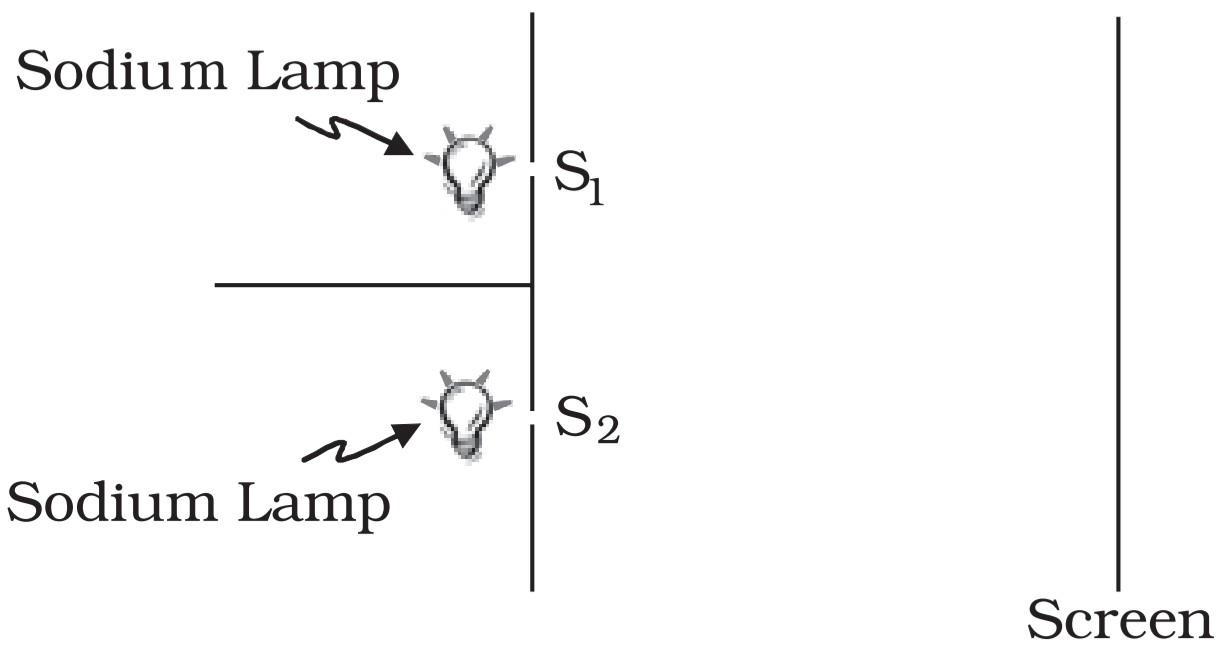
The light emitted from an oridinary source (like a sodium lamp) is unpolarised.
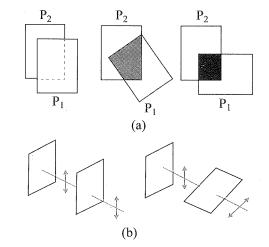
When such a light is passed through a polaroid sheet $P_1$, it is observed that its intensity is reduced by half. Rotating $P _{\text {, }}$ has no effect on the transmitted beam and transmitted intensity remains constant.
Now, let an identical piece of polaroid $P _2$ be placed before $P _1$.
As shown in Fig., initially $P_1$ and $P_2$ are arranged in such a way that their pass-axis are parallel to each other.
In this case, the intensity of the transmitted light is the same.
Now, if $P _1$ is rotated, there is variation seen in the light coming out of $P _2$.
As shown in a position in the fig., the intensity transmitted through $P_2$ followed by $P_1$ is nearly zero.
When $P _1$ is rotated by $90^{\circ}$, in one position for light coming from $P _2$, total intensity is absorbed by $P_1$. So, the intensity of light emerging from $P_1$ is zero.
Suppose, the pass axis of $P _2$ makes an angle $\theta$ with the pass axis of $P_1$, then when the polarised beam passes through the polaroid $P _2$, the component $E \cos \theta$ (along the pass-axis of $P_2$ ) will pass through $P_2$. Thus, as we rotate the polaroid $P _1$ (or $P _2$ ), the intensity will vary as :
$I = I _0 \cos ^2 \theta$
where $I_0$ is the intensity of the polarized light after passing through $P _1$.
This is known as Malus' law.
The above discussion shows that the intensity coming out of a single polaroid is half of the incident intensity. By putting a second polaroid, the intensity can be further controlled from $50 \%$ to zero of the incident intensity by adjusting the angle between the pass axis of two polaroids.


Need a full question paper?

Generate a complete, print-ready paper with questions like this in minutes — across 16+ boards, with answer keys.
Start Generating Free

Similar questions

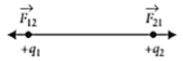
Coulomb's law states that the electrostatic force of attraction or repulsion acting between two stationary point charges is given by
Image

where F denotes the force between two charges $q _1$ and $q _2$ separated by a distance r in free space, $\varepsilon_0$ is a constant known as the permittivity of free space. Free space is a vacuum and may be taken to be air practically. If free space is replaced by a medium, then $\varepsilon_0$ is replaced by $\left(\varepsilon_0 k\right)$ or $\left(\varepsilon_0 \varepsilon_r\right)$ where k is known as dielectric constant or relative permittivity.

(i) In coulomb's law, $F =k \frac{q_1 q_2}{r^2}$, then on which of the following factors does the proportionality constant k depends?
(a) Nature of the medium between the two charges
(b) Distance between the two charges
(c) Electrostatic force acting between the two charges
(d) Magnitude of the two charges

(ii) Dimensional formula for the permittivity constant $\varepsilon_0$ of free space is
(a) $\left[ M ^{-1} L^3 T^2 A^2\right]$
(b) $\left[ ML ^{-3} T^4 A^2\right]$
(c) $\left[ M ^{-1} L^{-3} T^4 A^2\right]$
(d) $\left[ ML ^{-3} T^4 A^{-2}\right]$

(iii) The force of repulsion between two charges of 1 C each, kept 1m apart in vaccum is
(a) $\frac{1}{9 \times 10^9} N$
(b) $\frac{1}{9 \times 10^{12}} N$
(c) $9 \times 10^7 N$
(d) $9 \times 10^9 N$

(iv) Two identical charges repel each other with a force equal to 10 mgwt when they are 0.6 m apart in air. ( $g =$ $10 m s ^{-2}$ ). The value of each charge is
(a) 2 mC
(b) $2 \times 10^{-7} mC$
(c) $2 \mu C$
(d) 2 nC

OR

Coulomb's law for the force between electric charges most closely resembles with
(a) law of conservation of energy
(b) Newton's 2nd law of motion
(c) law of conservation of charge .
(d) Newton's law of gravitation
What are signals ? What do you mean by analog and digital signals ?
A car starts from rest on a half kilometer long bridge. The coefficient of friction between the tyre and the road is 1.0. Show that one cannot drive through the bridge in less than 10s.
Draw a block diagram of a generalized communication system. Write the functions of each of the following:
(a) Transmitter, (b) Channel, (c) Receiver.
A uniform magnetic field of 0.20 × 10-3 T exists in the space. Find the change in the magnetic scalar potential as one moves through 50cm along the field.
Mention the changes occurring in the geomagnetic components.
Using only NAND gate make combination diagrams to obtained NOT, AND and OR gates.
Step-down transformers are used to decrease or step-down voltages. These are used when voltages need to be lowered for use in homes and factories. A small town with a demand of 800kW of electric power at 220V is situated 15km away from an electric plant generating power at 440V. The resistance of the two wire line carrying power is 0.5Q per km. The town gets power from the line through a 4000 - 220V step-down transformer at a sub-station in the town.

  1. The value of total resistance of the wires is:
  1. $25\Omega$
  2. $30\Omega$
  3. $35\Omega$
  4. $15\Omega$
  1. The line power loss in the form of heat is:
  1. 550kW
  2. 650kW
  3. 600kW
  4. 700kW
  1. How much power must the plant supply, assuming there is negligible power loss due to leakage?
  1. 600kW
  2. 1600kW
  3. 500W
  4. 1400kW
  1. The voltage drop in the power line is:
  1. 1700V
  2. 3000V
  3. 2000V
  4. 2800V
  1. The total value of voltage transmitted from the plant is:
  1. 500V
  2. 4000V
  3. 3000V
  4. 7000V
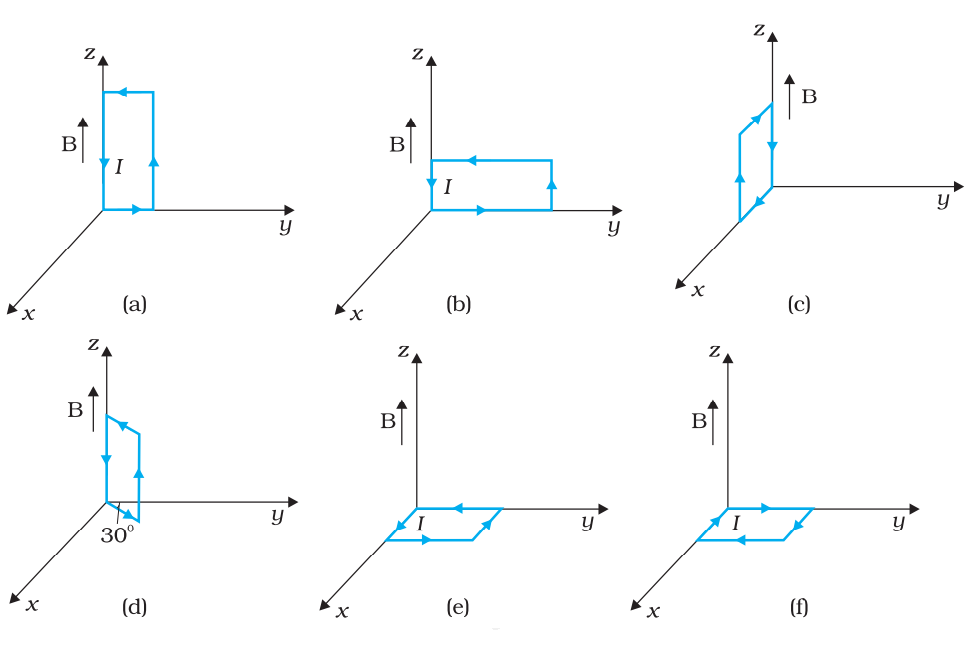
A uniform magnetic field of 3000 G is established along the positive z-direction. A rectangular loop of sides 10 cm and 5 cm carries a current of 12 A. What is the torque on the loop in the different cases shown in Fig.? What is the force on each case? Which case corresponds to stable equilibrium?