Question
Explain : "Electric charges are additive in nature."

Answer

→ If a system contains two point charges $q_1$ and $q_2$, the total charge of the system is obtained simply by adding them algebraically. i.e., total charge of the system is $q_1+q_2$.
→ If a system contains n charges $q_1, q_2, q_3, \ldots, q_n$, then the total charge of the system is $q_1+q_2+$ $q_3+\ldots+q_n$
→ Charge has magnitude but no direction, similar to mass. However, there is one difference between mass and charge. Mass of a body is always positive whereas a charge can be either positive or negative. Proper signs have to be used while adding the charges in a system.
→ For example, the total charge of a system containing five charges $+1,+2,-3,+4$ and -5 , in some arbitrary unit, is $(+1)+(+2)+(-3)+$ $(+4)+(-5)=-1$.
→ Thus, the total electric charge of any system is equal to the algebraic sum of the positive and negative electric charge at different points within the system.

Need a full question paper?

Generate a complete, print-ready paper with questions like this in minutes — across 16+ boards, with answer keys.
Start Generating Free

Similar questions

If the sound level in a room is increased from 50dB to 60dB, by what factor is the pressure amplitude increased?
A lamp attached to a cycle glows by a dynamo. When cycle is moved at greater speed, the lamp glows brightly and when cycle moves with a lesser speed, it glows dimly. Why?
Sketch graph to show how charge Q given to a capacitor of capacitance C varies with the potential difference.
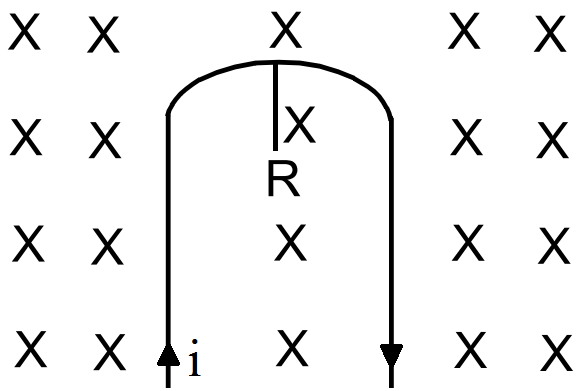
A rigid wire consists of a semi-circular portion of radius R and two straight sections The wire is partially immersed in a perpendicular magnetic field B, as shown in the figure. Find the magnetic force on the wire if it carries a current i.

What is magnetisation ? Derive the relationship between magnetisation and magnetic intensity.
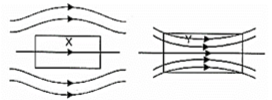
A uniform magnetic field gets modified as shown below, when two specimens X and Y are placed in it.

Image

i. Identify the two specimens X and Y.
ii. State the reason for the behaviour of the field lines in X and Y.
Explain why the spectrum of hydrogen atom has many lines, although a hydrogen atom contains only one electron.
What is image? Explain its types.
A copper wire bent in the shape of a semicircle of radius r translates in its plane with a constant velocity v. A uniform magnetic field B exists in the direction perpendicular to the plane of the wire. Find the emf induced between the ends of the wire if:
  1. The velocity is perpendicular to the diameter joining free ends.
  2. The velocity is parallel to this diameter.
Find the wavelength of electromagnetic waves of frequency 4 × 10⁹Hz in free space. Give its two applications.