Electric Charges and Fields — Physics STD 12 Science — Question
Gujarat BoardEnglish MediumSTD 12 SciencePhysicsElectric Charges and Fields2 Marks
Question
Explain electric field due to system of charges.
✓
Answer
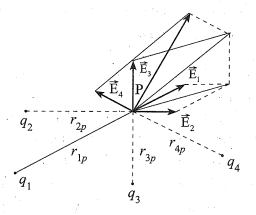
►Consider a system of charges $q_1, q_2, \ldots, q_n$ with position vectors $\vec{r}_1, \vec{r}_2, \ldots, \vec{r}_n$ relative to some origin O . ►We can use Coulomb's law and the superposition principle to determine this field at a point P denoted by position vector $\vec{r}$. ►Electric field $\left(\overrightarrow{ E }_1\right)$ at point P due to $q_1$, $\overrightarrow{ E }_1=\frac{1}{4 \pi \varepsilon_0} \frac{q_1}{r_{ IP }^2} \hat{r}_{ IP }$ ►where $\hat{r}_{ IP }$ is a unit vector in the direction from $q_1$ to P . and $r_{1 P }$ is the distance between $q_1$, and P . In the same manner, electric field $\left(\vec{E}_2\right)$ at point P due to $q_2$. $\overrightarrow{ E }_2=\frac{1}{4 \pi \varepsilon_0} \frac{q_2}{r_{2 P }^2} \hat{r}_{2 P }$ ►where $\hat{r}_{2 P }$ is a unit vector in the direction from $q_2$ to P and $r_{2 P }$ is the distance between $q_2$ and P . ►Similar expressions hold good for fields $\vec{E}_3$, $\overrightarrow{ E }_4, \ldots, \overrightarrow{ E }_n$ due to charges $q_3, q_4, \ldots, q_n$. ►By the superposition principle, the electric field E at r due to the system of charges is (as shown in Fig.) $\begin{aligned} \overrightarrow{ E }(r) & =\overrightarrow{ E }_1(r)+\overrightarrow{ E }_2(r)+\ldots+\overrightarrow{ E }_n(r) \\ & =\frac{1}{4 \pi \varepsilon_0} \frac{q_1}{r_{1 P }^2} \hat{r}_{1 P }+\frac{1}{4 \pi \varepsilon_0} \frac{q_2}{r_{2 PP }^2} \hat{r}_{2 P }+\ldots+\frac{1}{4 \pi \varepsilon_0} \frac{q_n}{r_{n P }^2} \hat{r}_{n P } \\ \overrightarrow{ E }(r) & =\frac{1}{4 \pi \varepsilon_0} \sum_{i=1}^n \frac{q_i}{r_{i P }^2} \hat{r}_{i P }\end{aligned}$
Need a full question paper?
Generate a complete, print-ready paper with questions like this in minutes — across 16+ boards, with answer keys.