Question
Explain electric field produced by the point electric charge.

Answer

Image
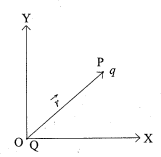
►Let us consider a point charge $Q$ placed in vacuum, at the origin $O$. If we place another point charge q at a point P , where $\overrightarrow{ OP }=\vec{r}$, then the charge $Q$ will exert a force on $q$ as per Coulomb's law.
►The external effect which produces force on charge q , is called electric field of charge $Q$.
►Electric field at point ' P '
$\overrightarrow{ E }(r)=\frac{1}{4 \pi \varepsilon_0} \cdot \frac{ Q }{r^2} \cdot \hat{r}$
Where $\hat{r}$ is the unit vector in the direction of electric field.
►The area around any electric charge or electric charge system where its effect prevails is called the electric field of the electric charge or electric charge system.
OR
►"In the region of an electric charge, or a system of charge, the electrostatic force acting on a unit positive charge placed at some point is called
the electric field of the given electric charge / system of charges."
►Electric field is a vector quantity.
►Its unit is $N / C$ or $V / m .\left( M ^1 L^1 T^{-3} A^{-1}\right)$

Need a full question paper?

Generate a complete, print-ready paper with questions like this in minutes — across 16+ boards, with answer keys.
Start Generating Free

Similar questions

Draw a sketch of a plane electromagnetic wave propagating along the z-direction. Depict clearly the directions of electric and magnetic fields varying sinusoidally with z.
The mass of a $H-$atom is less than the sum of the masses of a proton and electron. Why is this?
Define trans conductance of a transistor.
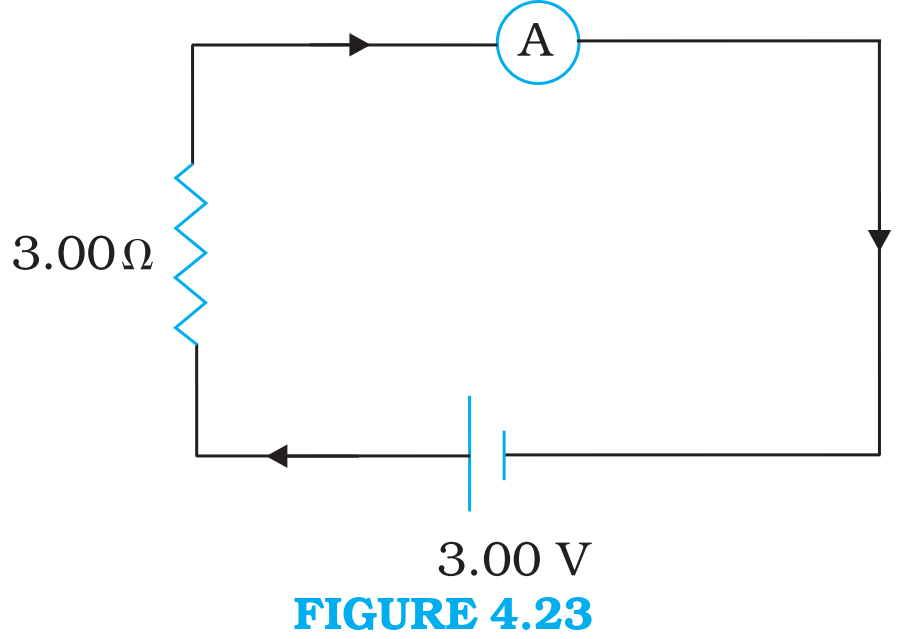
In the circuit (Fig. 4.23) the current is to be measured. What is the value of the current if the ammeter shown (a) is a galvanometer with a resistance $R_G=60.00 \Omega$; (b) is a galvanometer described in (a) but converted to an ammeter by a shunt resistance $r_s=0.02 \Omega$; (c) is an ideal ammeter with zero resistance?
Image
Write uses of X-rays.
Find the dimensions of:
  1. Electric field E,
  2. Magnetic field B and
  3. Magnetic permeability $\mu_0.$
The relevant equations are$\text{F = qE, F = qvB,}$ and $\text{B}=\frac{\mu_0\text{I}}{2\pi\alpha};$
where F is force, q is charge, v is speed, I is current, and a is distance.
Give some commonly known ideas regarding magnetism.
An inductor is connected to a battery through a switch. Explain why the emf induced in the inductor is much larger when the switch is opened as compared to the emf induced when the switch is closed.
An oil drop of $10^{-6} m$ diameter and density $880.5 kg / m ^3$ remains stationary between plates separated by 10 mm . The potential difference between the plates is 36 volts. Find the number of electrons on the oil drop. $\left( g =10 m / s ^2\right)$
Find the increase in mass when $1\ kg$ of water is heated from $0^\circ c$ to $100^\circ C.$ Specific heat capacity of water $= 4200J/kg-K.$