Question
Explain electric field produced by the point electric charge.

Answer

Image
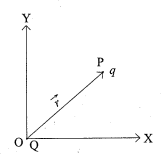
►Let us consider a point charge $Q$ placed in vacuum, at the origin $O$. If we place another point charge q at a point P , where $\overrightarrow{ OP }=\vec{r}$, then the charge $Q$ will exert a force on $q$ as per Coulomb's law.
►The external effect which produces force on charge q , is called electric field of charge $Q$.
►Electric field at point ' P '
$\overrightarrow{ E }(r)=\frac{1}{4 \pi \varepsilon_0} \cdot \frac{ Q }{r^2} \cdot \hat{r}$
Where $\hat{r}$ is the unit vector in the direction of electric field.
►The area around any electric charge or electric charge system where its effect prevails is called the electric field of the electric charge or electric charge system.
OR
►"In the region of an electric charge, or a system of charge, the electrostatic force acting on a unit positive charge placed at some point is called
the electric field of the given electric charge / system of charges."
►Electric field is a vector quantity.
►Its unit is $N / C$ or $V / m .\left( M ^1 L^1 T^{-3} A^{-1}\right)$

Need a full question paper?

Generate a complete, print-ready paper with questions like this in minutes — across 16+ boards, with answer keys.
Start Generating Free

Similar questions

Write Maxwell's equations.
A galvanometer has a resistance of 30Ω. It gives full scale deflection with a current of 2 mA. Calculate the value of the resistance needed to convert it into an ammeter of range 0-0.3 A.
Suppose the energy liberated in the recombination of a hole-electron pair is converted into electromagnetic radiation. If the maximum wavelength emitted is 820nm, what is the band gap?
Find the thermo-emf developed in a copper-silver thermocouple when the junctions are kept at 0°C and 40°C. Use the data in table.
 
Metal with
a
b
lead (Pb)
$\mu\text{V}/^\circ\text{C}$
$\mu\text{V}/^\circ(\text{C})^2$
Aluminium
-0.47
0.003
Bismuth
-43.7
-0·47
Copper
2.76
0·012
Gold
2.90
0.0093
Iron
16.6
-0.030
Nickel
19.1
-0.030
Platinum
-1.79
-0.035
Silver
2.50
0.012
Steel
10.8
-0.016
 
Taking force, length and time to be the fundamental quantities find the dimensions of:
  1. Density.
  2. Pressure.
  3. Momentum.
  4. Energy.
Write relation between conductivity and mobility of metal.
The radii of two conductors $A$ and $B$ with equal charge density are $R_1$ and $R_2$, respectively ( $R_1$ $>R_2$ ). If the conductors are connected to a conducting wire of negligible capacitance then find out :(a) From which conductor will the charge flowto whom?(b) What will be the ratio of charges on the conductors after charge redistribution?
Sound waves from a loudspeaker spread nearly uniformly in all directions if the wavelength of the sound is much larger than the diameter of the loudspeaker.
  1. Calculate the frequency for which the wavelength of sound in air is ten times the diameter of the speaker if the diameter is 20cm.
  2. Sound is essentially transmitted in the forward direction if the wavelength is much shorter than the diameter of the speaker. Calculate the frequency at which the wavelength of the sound is one tenth of the diameter of the speaker described above. Take the speed of sound to be 340m/s.
The force between two point charges kept at a distance r apart in air is F. If the same charges are kept in water at the same distance, how does the force between them change?
What is Curie law in magnetism?