Question
Explain Electric Flux.
Answer

►The number of electric field lines passing through a closed surface in an electric field is called electric flux.
►Suppose the electric field is $\overrightarrow{ E }$ and the area of the closed - surface is $\Delta S$, then the electric flux associated with this surface is given by
$\phi=\overrightarrow{ E } \cdot \overrightarrow{\Delta S }$

Image
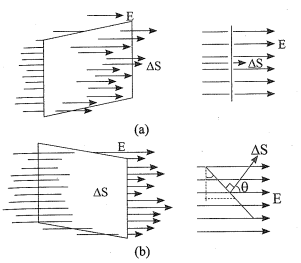
►As shown Fig. (a) electric flux associated with placing the electric field perpendicular to a small planar element of area $\Delta S$ is
$\begin{aligned}
\phi & = E \Delta S \cos \theta \text { (But } \overrightarrow{ E } \| \overrightarrow{\Delta S } \text { So, } \theta=0 \text { ) } \\
\therefore \quad \phi & = E \Delta S \text { (maximum) }
\end{aligned}$
►Now if we tilt the area $\Delta S$ by an angle of $\theta$ then the number of field lines passing through the area segment $\Delta S$ is Fig. (b) will be less than before. In this case the electric flux associated with the plane is found to be
$\phi= E \Delta S \cos \theta$

►If $\theta=90^{\circ}(\overrightarrow{ E } \perp \overrightarrow{\Delta S })$ no field line passes through the plane. As a result, zero electric flux associated with plane
$\phi= E \Delta S \cos 90^{\circ}=0$
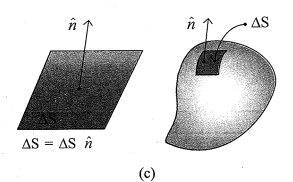
►As shown in Fig. (c), a curved surface is placed in an electric field.
Image
►To obtain the electric flux associated with this curved surface; consider this surface divided into many micro-sections. Each continent is so subtle that each continent can be considered a plane.
►The electric flux associated with any of the microscopic sections is
$\therefore \Delta \phi=\overrightarrow{ E } \cdot \overrightarrow{\Delta S }$
►Now if the total flux is to be obtained similarly the electric fluxes associated with all the subsections are obtained and then summed up. Hence, the total electric flux through the curve
$\therefore \phi=\sum \overrightarrow{ E } \cdot \overrightarrow{\Delta S }$
►Here, the electric field $\vec{E}$ is assumed to be constant for small piece. Now if $\Delta S \rightarrow 0$ is taken then the given sum turns into integral.
$\therefore \phi=\int \overrightarrow{ E } \cdot \overrightarrow{\Delta S }$
►Electric flux is a scalar quantity
Unit $\frac{ Nm ^2}{ C }$ OR Vm
►Dimensional Formula : $M ^1 L^3 T^{-3} A^{-1}$


Need a full question paper?

Generate a complete, print-ready paper with questions like this in minutes — across 16+ boards, with answer keys.

Start Generating Free

Similar questions

Explain linear density, surface density and volume density for continuous charge distribution.
A concave mirror having a radius of curvature 40cm is placed in front of an illuminated point source at a distance of 30cm from it. Find the location of the image.
Show that the ratio of the magnetic dipole moment to the angular momentum (l = mvr) is a universal constant for hydrogen-like atoms and ions. Find its value.
A charge Q is distributed uniformly over a metallic sphere of radius R. Obtain the expressions for the electric field (E) and electric potential (V) at a point 0 < x < R.
Show on a plot the variation of E and V with x for 0 < x < 2R.
A transverse wave described by

$\text{y}=(0.02\text{m})\sin\Big[(1.0\text{m}^{-1})\text{x}+(30\text{s}^{-1})\text{t}\Big]$

propagates on a stretched string having a linear mass density of 1.2 x 10⁻⁴kg/m. Find the tension in the string.

The stopping potential in a photoelectric experiment is linearly related to the inverse of the wavelength $\Big(\frac{1}{\lambda}\Big)$ of the light falling on the cathode. The potential difference applied across an X-ray tube is linearly related to the inverse of the cutoff wavelength$\Big(\frac{1}{\lambda}\Big)$ of the X-ray emitted. Show that the slopes of the lines in the two cases are equal and find its value.
A block of 2kg is suspended from the ceiling through a massless spring of spring constant k = 100N/m. What is the elongation of the spring? If another 1kg is added to the block, what would be the further elongation?
Two small balls A and B, each of mass m, are joined rigidly by a light horizontal rod of length L. The rod is clamped at the centre in such a way that it can rotate freely about a vertical axis through its centre. The system is rotated with an angular speed w about the axis. A particle P of mass m kept at rest sticks to the ball A as the ball collides with it. Find the new angular speed of the rod.
A semicircular rod is joined at its end to a straight rod of the same material and the same cross-sectional area. The straight rod forms a diameter of the other rod. The junctions are maintained at different temperatures. Find the ratio of the heat transferred through a cross section of the semicircular rod to the heat transferred through a cross section of the straight rod in a given time.
A parallel-plate capacitor having plate area 25cm2 and separation 1.00mm is connected to a battery of 6.0V. Calculate the charge flown through the battery. How much work has been done by the battery during the process?