Question
Explain electricity conduction in intrinsic semi-conductors.

Answer

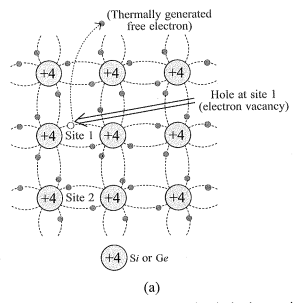
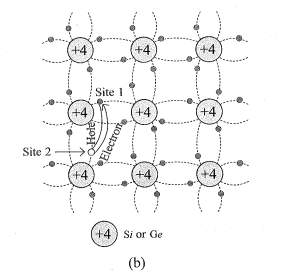
→As shown in Fig. (a), Suppose there is a hole at site-1. The movement of holes can be visualised as shown in the Fig (b).
→An electron from the covalent bond at site-2, may jump to the vacant site-1. (hole)
Image
→Thus, after such a jump, the hole is at site-2 and the site-1 has now an electron. Therefore, apparently, the hole has moved from site-1 to site-2. (So, the directions of motion of a hole and an electron are opposite).
Image
→Note that the electron originally set free (Fig. a) is not involved in the process of hole motion.
→The free electron moves completely independently as conduction electron and gives rise to an electron current, I under an applied electric field.
→Remember that the motion of hole is only a convenient way of describing the actual motion of bound electrons, whenever there is an empty bond anywhere in the crystal.
→Under the action of an electric field, these holes move towards negative potential giving the hole current, $I _h$.
→The total current, I is thus the sum of electron current $I _e$ and the hole current $I _h$ :
$\therefore I = I _e+ I _h$                                            .......(1)
→Apart from the process of generation of conduction electrons and holes, a simultaneous process of recombination occurs in which these electrons recombine with holes.
→At equilibrium, the rate of generation is equal to the rate of recombination of charge carries. The recombination occurs due to an electron colliding with a hole.

Need a full question paper?

Generate a complete, print-ready paper with questions like this in minutes — across 16+ boards, with answer keys.
Start Generating Free

Similar questions

Write a short note on 'Valves' in electronics.
A book is lifted from the floor and is kept in an almirah. One person says that the potential energy of the book is increased by 20J and the other says it is increased by 30J. Is one of them necessarily wrong?
Each of the batteries shown in figure has an emf equal to 5V. Show that the magnetic field B at the point P is zero for any set of values of the resistances.
A spherical surface of radius 30cm separates two transparent media A and B with refractive indices 1.33 and 1.48 respectively. The medium A is on the convex side of the surface. Where should a point object be placed in medium A so that the paraxial rays become parallel after refraction at the surface?
The force on a north pole,$\overrightarrow{\text{F}}=\text{m}\overrightarrow{\text{B}},$ is parallel to the field $\overrightarrow{\text{B}}.$ Does it contradict our earlier knowledge that a magnetic field can exert forces only perpendicular to itself?
Can a plane mirror ever form a real image?
Suppose the platform of the previous problem is brought to rest with the ball in the hand of the kid standing on the rim. The kid throws the ball horizontally to his friend in a direction tangential to the rim with a speed v as seen by his friend. Find the angular velocity with which the platform will start rotating.
The drift current in a p-n junction is $20.0\mu\text{A}.$ Estimate the number of electrons crossing a cross-section per second in the depletion region.
The minimum deviations suffered by red, yellow and violet beams passing through an equilateral transparent prism are 38.4°, 38.7° and 39.2° respectively. Calculate the dispersive power of the medium.
In the decay $^{64}Cu → ^{64}Ni + e^+ + v,$ the maximum kinetic energy carried by the positron is found to be 0.650MeV.
  1. What is the energy of the neutrino which was emitted together with a positron of kinetic energy 0.150MeV?
  2. What is the momentum of this neutrino in kg-m/s?
Use the formula applicable to a photon.