Question
Explain electrostatic potential.

Answer

The work done in taking the test charge from one point to the other point in the electric field created by an electric charge distribution is stored in the form of potential energy and is proportional to charge $q$.
If this work is divided by $q$, then the resulting quantity does not depend on $q$. In this way, work done per unit charge is the characteristic of electric field, which can be defined as static electric potential.
The work done by external force in taking unit positive charge from $R$ to P ,
$\frac{ W _{ RP }}{q}=\frac{ U _{ P }- U _{ R }}{q}= V _{ P }- V _{ R }=\Delta V$ Where, $V _{ P }$ and $V _{ R }$ are electrostatic potential at points $P$ and $R$ respectively.
There is no importance of absolute value of electric potential. It is only the difference of electric potential between two points, which is important.
If electric potential at infinite distance is taken zero then,
"Work done in bringing unit positive charge from infinity to the given point in the electric field, against the electric field is called electro static potential (V) at that point".
OR
→"In the region of static electric field, electric potential at any point, means work done by external force in bringing unit positive charge from infinity to that point, without acceleration."
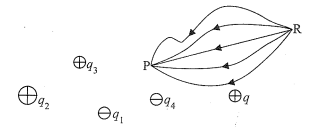
The work done in taking the test charge $q$ in the given electric field, does not depend on path. It depends only on the initial position and final position.

Image

As shown in the fig., in the resultant (net) electric field of electric charges $q_1, q_2, q_3$, $q_4$, the work done in taking the test charge $q$ from point R to P , on different paths, is found same which indicates that the work done is independent of path.

Need a full question paper?

Generate a complete, print-ready paper with questions like this in minutes — across 16+ boards, with answer keys.
Start Generating Free

Similar questions

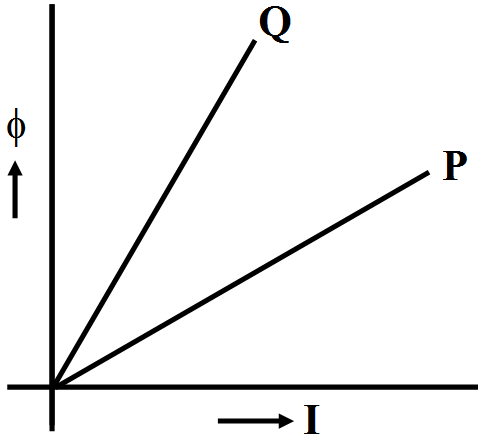
The given graph shows a plot of magnetic flux $(\phi)$ and the electric current (I) flowing through two inductors P and Q. Which of the two inductors has smaller value of self-inductance?
Estimate the number of electrons in $100g$ of water. How much is the total negative charge on these electrons?
A uniformly moving train passes by a long platform. Consider the events' engine crossing the beginning of the platform' and 'engine crossing the end of the platform'. Which frame (train frame or the platform frame) is the proper frame for the pair of events?
A charge $Q$ is uniformly distributed over a rod of length l. Consider a hypothetical cube of edge l with the centre of the cube at one end of the rod. Find the minimum possible flux of the electric field through the entire surface of the cube.
What are the advantages of using soft iron as a core, instead of steel, in the coils of galvanometers?
In a photodiode, the conductivity increases when the material is exposed to light. It is found that the conductivity changes only if the wavelength is less than 620nm. What is the band gap?
Two capacitors of capacitances $4.0\mu\text{F}$ and $6.0\mu\text{F}$ are connected in series with a battery of 20V. Find the energy supplied by the battery.
A railway track $($made of iron$)$ is laid in winter when the average temperature is $18^\circ C$. The track consists of sections of $12.0m$ placed one after the other. How much $pp$ should be left between two such sections $80$ that there is no compression during summer when the maximum temperature goes to $48^\circ C$? Coefficient of linear expansion of iron $= 11 \times 10^{-6 }{}^{\circ} C^{-1}$.
When a photon is emitted from an atom, the atom recoils. The kinetic energy of recoil and the energy of the photon come from the difference in energies between the states involved in the transition. Suppose, a hydrogen atom changes its state from $n = 3$ to $n = 2.$ Calculate the fractional change in the wavelength of light emitted, due to the recoil.