Question
Explain : Electrostatic shielding.

Answer

Image
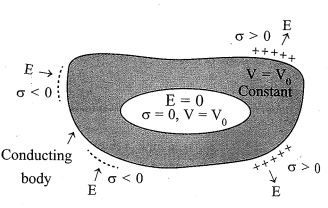
Consider a conductor with a cavity as shown in the figure.
The shape and size of the cavity can be any.
There is no charge in the cavity.
No matter what external field such a conductor is placed in the electric field in the cavity is zero.
Even if the conductor is charged, all charges, reside only on the outer surface of conductor with cavity.
Like this, there is no effect of the external electric field or electric charge on the cavity. which means the cavity remains shielded from outside charge and external electric field, which is known as electrostatic shielding.
This effect can be made of use in protecting sensitive equipments from outside electrical influence.
E.g. in monsoon season, if we are sitting in a car and lightening strikes, we should close the doors and windows of the car. By doing this, we happen to be in the cavity of car and we are protected due to electro static shielding.

Need a full question paper?

Generate a complete, print-ready paper with questions like this in minutes — across 16+ boards, with answer keys.

Start Generating Free

Similar questions

An electric field $\vec{\text{E}}=\vec{\text{i}}\text{Ax}$ exists in the space, where A= 10Vm-2. Take the potential at (10m, 20m) to be zero. Find the potential at the origin.
A slab of material of dielectric constant K has the same area as that of the plates of a parallel plate capacitor but has the thickness d/2, where d is the separation between the plates. Find out the expression for its capacitance when the slab is inserted between the plates of the capacitor.
Explain the effect of dielectric on the capacitance of parallel plate capacitor and derive the equation of dielectric constant.
Explain paramagnetism and paramagnetic substances.
Derive the equation (formula) showing the relationship between electric field and electric potential.
How does Ampere-Maxwell law explain the flow of current through a capacitor when it is being charged by a battery? Write the expression for the displacement current in terms of the rate of change of electric flux.
An inductor-coil carries a steady-state current of 2.0A when connected across an ideal battery of emf 4.0V. If its inductance is 1.0H, find the time constant of the circuit.
 An alternating voltage of frequency f is applied across a series LCR circuit. Let fr be the resonance frequency for the circuit. Will the current in the circuit lag, lead or remain in phase with the applied voltage when (i) f > f r, (ii) f < fr? Explain your answer in each case. 
Define Volume density of charge. Write its S.I. unit.
Explain controlled thermonuclear fusion.