Question
Explain ETS.

Answer

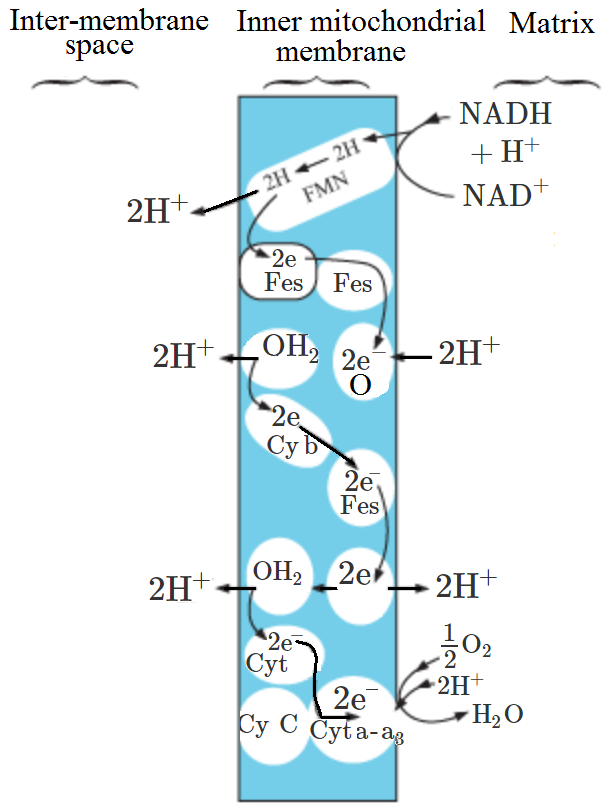
ETS or electron transport system is located in the inner mitochondrial membrane. It helps in releasing and utilizing the energy stored in NADH + H+ and FADH2. NADH + H+, which is formed during glycolysis and citric acid cycle, gets oxidized by NADH dehydrogenase (complex I). The electrons so generated get transferred to ubiquinone through FMN. In a similar manner, FADH2 (complex II) generated during citric acid cycle gets transferred to ubiquinone. The electrons from ubiquinone are received by cytochrome bc1 (complex III) and further get transferred to cytochrome c. The cytochrome c acts as a mobile carrier between complex III and cytochrome c oxidase complex, containing cytochrome- a and a3, along with copper centers (complex IV). During the transfer of electrons from each complex, the process is accompanied by the production of ATP from ADP and inorganic phosphate by the action ATP synthase (complex V). The amount of ATP produced depends on the molecule, which has been oxidized. 2 ATP molecules are produced by the oxidation of one molecule of NADH. One molecule of FADH2, on oxidation, gives 3 ATP molecules.
Need a full question paper?

Generate a complete, print-ready paper with questions like this in minutes — across 16+ boards, with answer keys.

Start Generating Free

Similar questions

Given below are floral formulae of some plants. Draw floral diagrams from these formulae.

Write the main characteristics of phylum Porifera. While classifying it, give an example of each category.
Deepak, (student of XI class), attended a seminar on plant growth and development. As Deepak also belongs to the farmer's family, he was enthusiastic to know upcoming experiments in the field of botany. Guest of the seminar told the students that development in plants is under the control of various intrinsic and extrinsic factors. The intrinsic factors include intracellular or genetic factors as well as intercellular factors like plant growth regulators.
Deepak asked the guest about the role of growth regulators used to improve the yield of plants. The guest speaker cleared all doubts of Arun and then Arun returned home happily from the seminar he visited.
  1. What are the two groups of PGRs, based on their functions?
  2. Give an example of each of the two types.
  3. It is said that PGRs may function synergistically of antagonistically. What is meant by these two terms? Give an example for each.
  4. What value can be learnt by the nature of Deepak (as a XI class student).
Explain fertilization and development in pheretima.
Briefly describe the structure of brain.
Describe the arrangement of floral members in relation to their insertion on thalamus.
Explain the nature of enzyme action in detail.
How are the male and female gametophytes of pteridophytes and gymnosperms different from each other?
What is oxidative phosphorylation?
Differentiate between
Aerobic respiration and fermentation