Question
Explain free radical polymerisation with example.

Answer

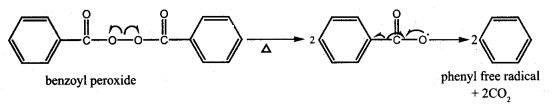
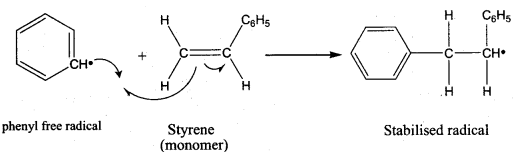
1. When alkenes are heated with free radical initiator such as benzoyl peroxide, they undergo polymerisation reaction. For example, styrene polymerises to polystrene when it is heated with a peroxide initator. The mechanism involves the following steps.

2. Initiation – Formation of free radical.
Image
3. Propagation step.
Image
4. Chain growth will continue with the successive addition of several thousands of monomer units.

5. Termination:
The above chain reaction can be stopped by stopping the supply of monomer or by coupling of two chains or reaction with an impurity such as oxygen.
Image

Need a full question paper?

Generate a complete, print-ready paper with questions like this in minutes — across 16+ boards, with answer keys.
Start Generating Free

Similar questions

What ¡s the $pH$ of $0.001 M$ aniline solution? The ionisation constant of aniline is $4.27 \times 10-10$. Calculate degree of ionization of aniline in the solution. Also calculate the ionisation constant of the conjugate acid of anile.
Explain the preparation of silicones.
Indicate the types of isomerism exhibited by the following complexes and draw the structures for these isomers:
1. $K \left[ Cr \left( H _2 O \right)_2\left( C _2 O _4\right)_2\right]$
2. $\left[ CO ( NH )_3 Cl \right] Cl _2$
3. $K _3\left[ Fe ( CN )_6\right]$
4. $K _3\left[ Fe \left( C _2 O _4\right)_3\right]$
5. $K _2\left[ PdCl _4\right]$
6. $\left[ Pt \left( NH _3\right)_2 Cl \left( NH _2 CH _3\right)\right] Cl$
An aromatic compound ' $A$ ' of molecular formula $C _7 H _7 ON$ undergoes a series of reactions as shown below. Write the structures of $A, B, C, D$ and $E$ in the following reactions.
Image
Discuss the applications of the Ellingham diagram:
An element crystallizes in a fcc lattice with cell edge of 400 pm . The density of the element is $7 g / cm ^3$. How many atoms one present in 280 g of the element?
 A simplest aromatic hydrocarbon (A) reacts with methyl chloride in the presence of $AlCl _3$ gives (B) $C _7 H _8$. Compound (B) reacts with $Br _2$ along with light gives (C) of molecular formula $C _7 H _7 Br (C)$ reacts with alcohol KCN gives ( D ) $\left( C _8 H _7 N\right.$ ) ( D ) on acid hydrolysis gives ( E ) of formula $C _8 H _8 O _2$. Identify $A , B , C , D , E$ and explain the reactions involved.
Describe about the structure, nature and properties of starch.
Explain about Electrophoresis (or) Cataphoresis (or) How would you detect the presence of charges on sol particles? (or) Explain about the method used to detect the presence of charge on sol particles. Electrophoresis (or) cataphoresis:
Describe about lead storage battery construction and its uses.