Question
Explain full wave rectification with the help of proper circuit diagram and draw the waveform of input and output voltage.
Answer


Image

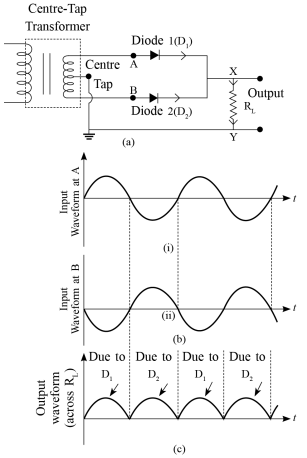
→ The circuit diagram of the full-wave rectifier is shown in the figure. In full wave rectifier, two $p-n$ junction diodes are used.
→ In this type of rectifier, the rectified output voltage is obtained during both the positive as well as negative half of ac cycle. Hence, it is known as full-wave rectifier.
→ As shown in fig., the $p$-side of the two diodes are connected to the ends of the secondary of the transformer. The $n$-side of the diodes are connected together and the output is taken between this common point of diodes and the mid-point of the secondary of the transformer. So for a full wave rectifier the secondary of the transformer is provided with a centre tapping and so it is called centre-tap transformer.
→ As can be seen from fig. (c), the voltage rectified by each diode is only half the total secondary voltage. Each diode rectifies only for half the cycle, but the two do so for alternate cycles. Thus the output between their common terminals and the centre tap of the transformer becomes a full-wave rectifier output.
→ Suppose the input voltage to $A$ with respect to centre tap at any instant is positive. At that instant, voltage $B$ being out of phase should be negative. In this case, diode $D_1$ gets forward biased and conducts, while $D_2$ gets reverse biased and does not conduct. Hence, as shown in fig. c, output current is obtained between two terminals of $R_L$ during this half-cycle.
→ During the other half-cycle, voltage at $A$ is negative and voltage at $B$ is positive. In this case diode $D_1$ is in reverse bias condition and $D_2$ is in forward bias. Hence, in this part of cycle, $D_2$ conducts and output voltage is obtained.
→ Thus, we get output voltage during both positive as well as negative half of the cycle.

Need a full question paper?

Generate a complete, print-ready paper with questions like this in minutes — across 16+ boards, with answer keys.

Start Generating Free

Similar questions

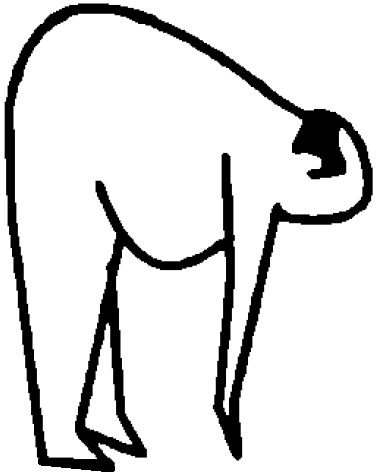
When a fat person tries to touch his toes, keeping the legs straight, he generally falls. Explain with reference to figure.

In an electromagnetic wave both the electric and magnetic fields are perpendicular to the direction of propagation, that is why electromagnetic waves are transverse in nature. Electromagnetic waves carry energy as they travel through space and this energy is shared equally by the electric and magnetic fields. Energy density of an electromagnetic waves is the energy in unit volume of the space through which the wave travels.
  1. The electromagnetic waves propagated perpendicular to both $\vec{\text{E}}$ and $\vec{\text{B}}.$ The electromagnetic waves travel in the direction of.
  1. $\vec{\text{E}}\times\vec{\text{B}}$
  2. $\vec{\text{E}}\times\vec{\text{B}}$
  3. $\vec{\text{B}}\times\vec{\text{E}}$
  4. $\vec{\text{B}}\times\vec{\text{E}}$
  1. Fundamental particle in an electromagnetic wave is:
  1. Photon
  2. Electron
  3. Phonon
  4. Proton
  1. Electromagnetic waves are transverse in nature is evident by:
  1. Polarisation
  2. Interference
  3. Reflection
  4. Diffraction
  1. For a wave propagating in a medium, identify the property that is independent of the others.
  1. Velocity
  2. Wavelength
  3. Frequency
  4. All these depend on each other.
  1. The electric and magnetic fields of an electromagnetic waves are:
  1. In opposite phase and perpendicular to each other.
  2. In opposite phase and parallel to each other.
  3. In phase and perpendicular to each other.
  4. In phase and parallel to each other.
In motor vehicles, a convex mirror is attached near the driver's seat to give him the view of the traffic behind. What is the special function of this convex mirror which a plane mirror can not do?
In a microwave oven, the food is kept in a plastic container and the microwave is directed towards the food. The food is cooked without melting or igniting the plastic container. Explain.
The spectral series of hydrogen atom were accounted for by Bohr using the relation $\text{V}=\text{R}\Bigg(\frac{1}{\text{n}^2_1}-\frac{1}{\text{n}^2_2}\Bigg)$where R = Rydberg constant = 1.097 × 10⁷m-1 Lyman series is obtained when an electron jumps to first orbit from any subsequent orbit. Similarly, Balmer series is obtained when an electron jumps to 2nd orbit from any subsequent orbit, Paschen series is obtained when an electron jumps to 3rd orbit from any subsequent orbit. Whereas Lyman series lies in U.V. region, Balmer series is in visible region and Pasch en series lies in infrared region. Series limit is obtained when n2$\infty$
  1. The wavelength of first spectral line of Lyman series is.
  1. 1215.4A
  2. 12154cm
  3. 1215.4m
  4. 1215.4mm
  1. The wavelength limit of Lyman series is.
  1. 1215.4A
  2. 511.9A
  3. 951.6A
  4. 911.6A
  1. The frequency of first spectral line of Bahner series is.
  1. 1.097 × 10⁷Hz
  2. 4.57 × 10¹⁴Hz
  3. 4.57 × 10¹⁵Hz
  4. 4.57 × 10¹⁶Hz
  1. Which of the following transitions in hydrogen atoms emit photons of highest frequency?
  1. n = 1 to n = 2
  2. n = 2 to n = 6
  3. n = 6 to n = 2
  4. n = 2 to n = 1
  1. The ratio of minimum to maximum wavelength in Balmer series is.
  1. 5 : 9
  2. 5 : 36
  3. 1 : 4
  4. 3 : 4
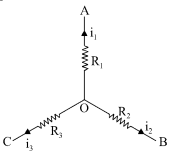
In the given figure, a part ABC of electric circuit is shown. The magnitudes of potentials at points $A, B$ and $C$ are and respectively, then find the value of potential at point $O$.
Image
 For the past some time, Aarti had been observing some erratic body movement, unsteadiness and lack of coordination in the activities of her sister Radha, who also used to complain of severe headache occasionally. Aarti suggested to her parents to get a medical check-up of Radha. The doctor thoroughly examined Radha and diagnosed that she has a brain tumour.
  1. What, according to you, are the values displayed by Aarti?
  2. How can radioisotopes help a doctor to diagnose brain tumour? 
Out of the two magnetic materials, 'A' has relative permeability slightly greater than unity while 'B' has less than unity. Identify the nature of the materials 'A' and 'B'. Will their susceptibilities be positive or negative?
Determine the current in each branch of the network shown in figure.
Image
In one of the exercises to strengthen the wrist and fingers, a person squeezes and releases a soft rubber ball. Is the work done on the ball positive, negative or zero during compression? During expansion?