Question
Explain Gabriel phthalimide synthesis.

Answer

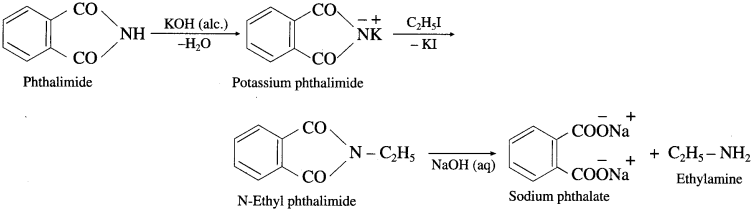
Phthalimide is reacted with alcoholic KOH to form potassium phthalimide. Further potassium phthalimide is treated with an ethyl iodide. The product N-ethylphthalimide is hydrolysed with aq NaOH to form ethyl amine. This reaction is known Gabriel phthalimide synthesis.

Image

Need a full question paper?

Generate a complete, print-ready paper with questions like this in minutes — across 16+ boards, with answer keys.
Start Generating Free

Similar questions

Distinguish between methanamine, dimethanamine and trimethanamine using Hinsberg’s reagent.
A solution containing $0.73 g$ of camphor (molar mass $152 g mol ^{-1}$ ) in $36.8 g$ of acetone (boiling point $56.3^{\circ} C$ ) boils at $56.55^{\circ} C$. A solution of $0.564 g$ of unknown compound in the same weight of acetone boils at $56.46^{\circ} C$. Calculate the molar mass of the unknown compound.
For a certain second order reaction energy of activation is $240 \ kJ \ mol^{-1}.$ Calculate its rate constant at $1023 K$ if the rate constant at $923$ is $0.0113 \ m^{-1} s^{-1}. [R= 8.314  \ JK^{-1} \ mol^{-1}]$
What are the physical properties of ozone?
In the Arrhenius equation for a first order reaction, the values of $' A \ '$ and $' E _{ a } \ '$ are $4 \times 10^{13} sec ^{-1}$ and $98.6 \ kJ \ mol ^{-1}$ respectively. At what temperature will its half life period be $10$ minutes? $\left[R=8.314 \ JK \ ^{-1} \ mol ^{-1}\right]$
Write a reaction to distinguish acetaldehyde from acetone
Why is the first ionisation energy of oxygen lower than that of nitrogen?
An organic compound A with molecular formula $C_4H_{10}O$ on treatment with phosphorus pentachloride gives alkyl chloride. Alkyl chloride on treatment with Mg in presence of dry ether gives a highly reactive compound B.
Compound B reacts with water to give hydrocarbon C. Alkyl chloride on treatment with Na in dry ether as a solvent gives alkane, $2,2,3,3$-tetramethylbutane. Identify ‘A’, ‘B’, ‘C’
Describe anomalous behaviour of fluorine with the other elements of group 17 with reference to :
(a) Hydrogen bonding
(b) Oxidation state
(c) Polyhalide ions.
Define molal elevation constant (Ebullioscopic constant)? Does it depend on the nature of a solute ? What are its units ?