Question
Explain geometrical isomerism in octahedral Complex.

Answer

$\rightarrow$ This type of isomerism arises in heteroleptic complexes due to different possible geometric arrangements of the ligands.
$\rightarrow$ Important examples of these behaviour are found with coordination numbers $4$ and $6.$
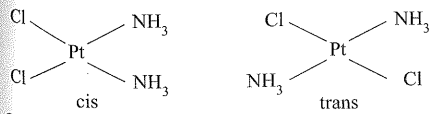
$\rightarrow$ In a square planar complex of formula $[MX_2L_2] (X$ and $L$ are unidentate$),$ the two ligands $X$ may be arranged adjacent to each other in a cis isomer, or opposite to each other in a trans isomer.
Image
Geometrical isomers $($cis and trans$)$ of $Pt[(NH_3)_2Cl_2]$
$\rightarrow$ Other square planar complex of the type $ \text{MABXL} ($where $A, B, X, L$ are unidentates$)$ shows three isomers$-$two cis and one trans.
$\rightarrow$ Such isomerism is not possible for a tetrahedral geometry.
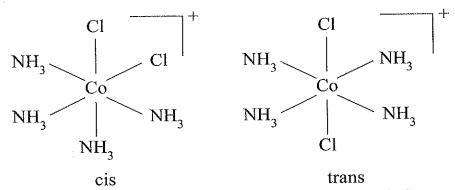
$\rightarrow$ In octahedral complexes of formula $[MX_2L_4]$ in which the two ligands $X$ may be oriented cis or trans to each other
Image
Geometrical isomers $($cis and trans$)$ of $[Co(NH_3)_4Cl_2]^+$
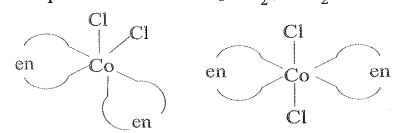
$\rightarrow$ This type of isomerism also arises when didentate ligands $L-L [$e.g., $en ]$ are present in complexes of formula $[MX_2(L-L)_2]$
Image
Geometrical isomers $($cis and trans$)$ of $[CoCl_2(en)_2]$
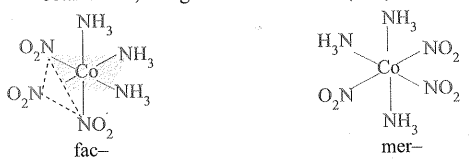
$\rightarrow$ Another type of geometrical isomerism occurs in octahedral coordination entities of the type $[Co(NH_3)_3(NO_2)_3].$
$\rightarrow$ If three donor atoms of the same ligands occupy adjacent positions at the corners of an octahedral face, it forms the facial $($fac$)$ isomer.
$\rightarrow$ When the positions are around the meridian of the octahedron, we get the meridional $($mer$)$ isomer.
Image
The facial $($fac$)$ and meridional $($mer$)$ isomers of $[Co(NH_3)_3(NO_2)_3]$

Need a full question paper?

Generate a complete, print-ready paper with questions like this in minutes — across 16+ boards, with answer keys.
Start Generating Free

Similar questions

What is depression of Freezing point ? What is molal depression constant $(K_f)$ ? Derive it's formula of finding molar mass of solute.
Explain the following:
(i) Electrophilic chlorination (substitution) of toluene.
(ii) Free radical halogenation of alkanes.
Explain Daniell cell with diagram and explain different condition when external potential is applied in opposite direction.
Read the following text carefully and answer the questions that follow:
The f$-$block consists of elements in which $4f$ and $5f$ orbitals are progressively filled. They are placed in a separate panel at the bottom of the periodic table. The names transition metals and inner transition metals are often used to refer to the elements of d$-$and f$-$blocks respectively. The d$-$block occupies the large middle section of the periodic table flanked between s and p blocks in the periodic table. In general, the electronic configuration of the outer orbitals of these elements is $(n-1)d^{1-10}ns^{1-2}.$ The electronic configurations of outer orbitals of $Zn, Cd, Hg$ and $Cn$ are represented by the general formula $(n - 1)d^{10}ns^2.$ The transition metals and their compounds also exhibit catalytic property and paramagnetic behaviour. Transition metal also forms an alloy. An alloy is a blend of metals prepared by mixing the components. Alloys may be homogeneous solid solutions in which the atoms of one metal are distributed randomly among the atoms of the other.
$i.$ Transition metals form alloys. Justify?
$ii.$ Why do transition elements exhibit higher enthalpies of atomization?
$iii.$ Transition metals and many of their compounds show paramagnetic behaviour. Give reason.
Crystal structure of oxides of transition metals often show defects. Given reason. (2)
What is ligand? Explain classification of ligand.
Read the following text carefully and answer the questions that follow:
Aariv Sharma is very fond of a special drink made by his grandmother using different fruits available in their hometown. It has an outstanding taste and also provide great health benefits of natural fruits. He thought of utilizing his grandmother recipe to create a new product in the beverage market that provide health benefits and also contain fizziness of various soft drinks available in the market.
$i.$ How he can add fizz to the special drink made by his grandmother? 
$ii.$ What is the law stated in the chapter that can help Aariv to make his drink fizzy?
$iii.$ What precautions he should take while bottling so that his product does not lose fizz during storage and handling across long distances? 
Write down reaction of halogens with metals. ### Give Fittig, Wurtz - Fittig and Grignard reaction of haloarene.
Explain colour in coordination compounds.
Explain with chemical equations, various methods for the preparation of benzaldehyde by oxidation of methylbenzene.