Question
Explain geometrical isomerism with the help of suitable example.

Answer

SELF

Need a full question paper?

Generate a complete, print-ready paper with questions like this in minutes — across 16+ boards, with answer keys.

Start Generating Free

Similar questions

Explain the following :
(a) isomerisation of alkanes
(b) aromaticity
(c) thermal decomposition
Perform the following calculations and express the results to proper number of significant figures.
  1. 144.3 m2 + (2.54 m × 8.4 m).
  2. (4.05 × 10²mL) - (0.0225 × 10²mL).
  3. (3.50 × 102cm) (4.00 × 106cm).
Arrange the following metals in the order in which they displace each other from the solution of their salts.

Al, Cu, Fe, Mg and Zn.

The ionization constant of acetic acid is 1.74 × 10⁻⁵. Calculate the degree of dissociation of acetic acid in its 0.05M solution. Calculate the concentration of acetate ion in the solution and its pH.
A compound made up of two elements A and B has A = 70%, B = 30%. Their relative number of moles in the compound are 1.25 and 1.88. Calculate.
  1. Atomic masses of the elements A and B.
  2. Molecular formula of the compound, if its molecular mass is found to be 160.
The concentration of sulphide ion in 0.1 M HCl solution saturated with hydrogen sulphide is $1.0 \times 10^{-19} M$. If 10 mL of this is added to 5 mL of 0.04 M solution of the following : $FeSO _4, MnCl _2$, $Z n C l _{ 2 }$ and $C d C l _{ 2 }$. In which of these solutions precipitation will take place?
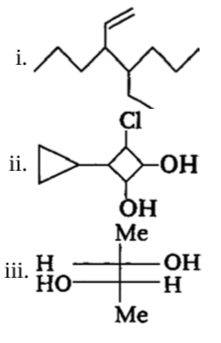
1. Give IUPAC names of the following structures.
Image
2. Benzoic acid is an organic compound. Its crude sample can be purified by crystallization from hot water. What characteristic differences in the properties of benzoic acid and the impurity make this process of purification suitable?
Explain the second and third law of thermodynamics.
For electrophilic substitution reaction functional groups present in singly substituted benzene derivatives. Explain the directive effect and also explain their activating and deactivating nature on basis of resonance.
How would you explain the fact that the first ionization enthalpy of sodium is lower than that of magnesium but its second ionization enthalpy is higher than that of magnesium?