Question
Explain ground state and ionisation energy of hydrogen atom.
Answer

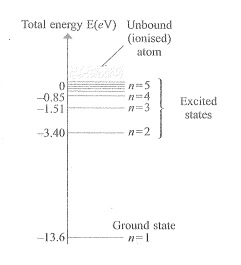
$\rightarrow$ The energy of an atom is the least when its electron is revolving in an orbit closest to the nucleus i.e., for $n=1$.
$\rightarrow$ As the value of $n$ increases, the energy of the electron also increases.
$\rightarrow$ The lowest state of the atom is called the ground state, is that of lowest energy, with the electron revolving in the orbit of smallest radius, the Bohr radius $\left(a_0\right)$.

Image
The energy of this state
$E _n=-\frac{13.6}{n^2} e V$
$n=1$
$E _1=-13.6 eV$
$\rightarrow$​​​​​​​ Therefore, the minimum energy required to free the electron from the ground state of the hydrogen atom is $13.6 eV$ . It is called the ionisation energy of a the hydrogen atom.

Need a full question paper?

Generate a complete, print-ready paper with questions like this in minutes — across 16+ boards, with answer keys.

Start Generating Free

Similar questions

An alternating voltage of frequency $f$ is applied across a series $\text{LCR}$ circuit. Let $f_r$ be the resonance frequency for the circuit. Will the current in the circuit lag, lead or remain in phase with the applied voltage when $(i)\ f > f_r, (ii)\ f < f_r$? Explain your answer in each case.
If an object far away from a convex mirror moves towards the mirror, the image also moves. Does it move faster, slower or at the same speed as compared to the object?
The magnetic properties of the different materials A, B and C are shown in the following table:
Material Permeability Susceptibility Temperature dependence of susceptibility.
A Low positive Small but negative Independent of temperature
B High Very high 1 Susceptibility decreases with temperature
C Greater than 1  Small but positive Decreases with temperature
Which of the above three materials should be used for making an electromagnet and why?
An electric dipole of length 2 cm, when placed with its axis making an angle of $60^\circ$with a uniform electric field, experiences a torque of $8\sqrt{3}$ Nm. Calculate the potential energy of the dipole, if it has a charge of $\pm4\text{nC}.$
$A$ small block $B$ is placed on another block $A$ of mass $5\ kg$ and length $20\ cm.$ Initially the block $B$ is near the right end of block $A. A$ constant horizontal force of $10N$ is applied to the block $A$. All the surfaces are assumed frictionless. Find the time elapsed before the block $B$ separates from $A.$
In half-wave rectification, what is the output frequency if the input frequency is 50 Hz. What is the output frequency of a full-wave rectifier for the same input frequency.
It is said that the separation between the two charges forming an electric dipole should be small. Small compared to what?
What will be the change in the resistance of wire of eureka if its radius is made half and length is made one-fourth?
Discuss the results of the Geiger-Marsden $\alpha$-particle scattering experiment with necessary graphs.
Explain Ohm's law.