Question
Explain Heisenberg's uncertainty principle and also explain its importance.

Answer

SELF

Need a full question paper?

Generate a complete, print-ready paper with questions like this in minutes — across 16+ boards, with answer keys.
Start Generating Free

Similar questions

The average concentration of $\mathrm{SO}_2$ in atmosphere over a city on a certain day is 10 ppm , when the average temperature is 298 K . Given that the solubility of $\mathrm{SO}_2$ in water at 298 K is $1.3653 \mathrm{~mol} / \mathrm{L}$ and the $\mathrm{pK}_{\mathrm{a}}$ of $\mathrm{H}_2 \mathrm{SO}_3$ is 1.92 , estimate the pH of acid rain on that day.
  1. State Henry's Law.
  2. Assign reason for the following:
  1. A solution of $NH_4Cl$ in water shows pH less than 7.
  2. In qualitative analysis $NH_4Cl$ is added before adding $NH_4OH$ for testing $Fe^{3+}$ or $AP^{3+}$ ions.
  1. Consider the reaction:
$\text{N}_2(\text{g})+3\text{H}_2(\text{g})\rightleftharpoons2\text{NH}_3+\text{Heat}$
Indicate the direction in which the equilibrium will shift when:
  1. Temperature is increased.
  2. Pressure is increased.
1. Will $CCl _4$ give a white precipitate of AgCl on heating it with $AgNO _3$ ?
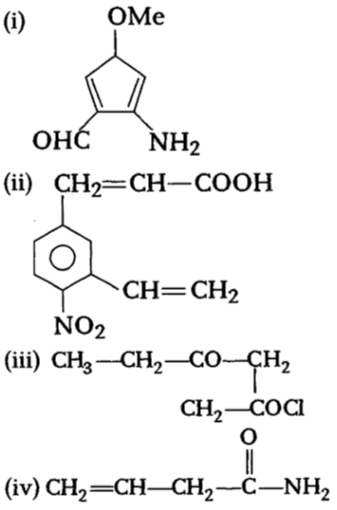
2. Identify the functional groups present in the following compounds.
Image
Explain why the following compounds behave as Lewis acids?
  1. $BCl_3$.
  2. $AlCl_3$.
  1. Out of different gases formed in Duma's method, which gas is not absorbed over an aqueous solution?
  2. What is function of $K_2SO_4$ and a little of $CuSO_4$​​​​​​​ added in Kjeldahl's flask?
  3. 0.4g of compound was Kjeldahl's and ammonia evolved was absorbed into 50mL of $\frac{\text{M}}{4}\text{ H}_2\text{SO}_4$ The residual acid was diluted with distilled water and made up to 150mL. 20mL of this diluted acid required 31mL of $\frac{\text{M}}{4}\text{ NaOH}$ solution for complete neutralisation. Calculate % of N in compound.
Match the correct ionisation enthalpies and electron gain enthalpies of the following elements:
 
Elements
 
$\Delta\text{H}_1$
$\Delta\text{H}_2$
$\Delta_{\text{eg}}\text{H}$
i.
Most reactive non metal
A.
419
3051
-48
ii.
Most reactive metal
B.
1681
3374
-328
iii.
Least reactive element
C.
738
1451
-40
iv.
Metal forming binary halide
D.
2372
5251
+8
$2\text{NO}(\text{g})+\text{O}_2(\text{g})\rightleftharpoons2\text{NO}_2(\text{g});\Delta\text{H}=-17\text{KJ}$
  1. Predict the effect of an increase in concentration of $\mathrm{NO}$ on the equilibrium concentration of $\mathrm{NO}_2$.
  2. Predict the effect of pressure decrease as a result of increased volume on the equilibrium concentration of $\mathrm{NO}_2$.
The ionization constant of propanoic acid is $1.32 \times 10^{–5}$​​​​​​​. Calculate the degree of ionization of the acid in its 0.05M solution and also its pH. What will be its degree of ionization if the solution is 0.01M in HCl also?
Show that the circumference of the Bohr orbit for the hydrogen atom is an integral multiple of the de Broglie wavelength associated with the electron revolving around the orbit.
Arrange the following in order of their increasing masses in gram (i) One atom of silver, (ii) one gram-atom of nitrogen, (iii) one mole of calcium, (iv) one mole of oxygen molecules, (v) $1023$ atoms of carbon and (vi) one gram of iron.