Question
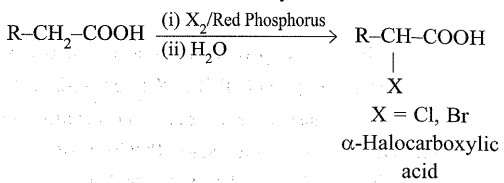
Explain Hell-Volhard-Zelinsky reaction of carboxylic acids.
Answer

→ Carboxylic acids having an $\alpha$-hydrogen are halogenated at the $\alpha$-position on treatment with chlorine or bromine in the presence of small amount of red phosphorus to give $\alpha$-halocarboxylic acids. The reaction is known as Hell-Volhard-Zelinsky reaction.
Image

Need a full question paper?

Generate a complete, print-ready paper with questions like this in minutes — across 16+ boards, with answer keys.

Start Generating Free

Similar questions

Give reason for the following:
Benzaldehyde reduces Tollens’ reagent but not the Fehling’s or Benedict’s solution.
Aqueous solution of TiCl3 is coloured where as aqueous solution of TiCl4 is colourless. Give reason.
Compare the general characteristics of the first series of the transition metals with those of the second and third series metals in the respective vertical columns. Give special emphasis on the following points:
Ionisation enthalpies.
Explain Werner's Theory for Co-ordination Compound.
Write a note on Cannizzaro reaction.
The following data were obtained during the first order thermal decomposition of SO2Cl2 at a constant volume:
SO2Cl2(g) $\rightarrow$SO2(g) + Cl2(g)
Experiment
Time/s–1
Total pressure/atm
1
0
0.4
2
100
0.7
Calculate the rate constant.
(Given: log4 = 0.6021, log2 = 0.3010).
What are reduction potential and oxidation potential?
Accomplish the following conversion:
Aniline to benzyl alcohol
  1. Following reactions occur at cathode during the electrolysis of aqueous silver chloride solution:

Ag+(aq) + e- $\rightarrow$  Ag(s)               E= +0.80 V

H+(aq) + e- $\rightarrow$ H2(g)                  Eo = 0.00 V

On the basis of their standard reduction electrode potential (Eo) values, which reaction is feasible at the cathode and why?

  1. Define limiting molar conductivity. Why conductivity of an electrolyte solution decreases with the decrease in concentration?
Explain the fact that in aryl alkyl ethers (i) the alkoxy group activates the benzene ring towards electrophilic substitution and (ii) it directs the incoming substituents to ortho and para positions in benzene ring.