Question
Explain how a Zener diode maintains constant voltage across a load.

Answer

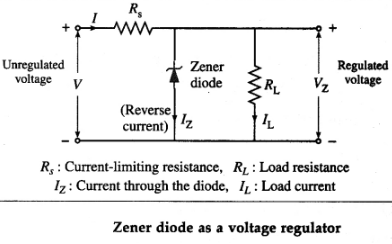
Principle : In the breakdown region of a Zener diode, for widely changing Zener current, the voltage across the Zener diode remains almost constant.

Image
Electric circuit : The circuit for regulating or stabilizing the voltage across a load resistance RL against change in load current and supply voltage is shown in above figure. The Zener diode is connected parallel to load Rh such that the current through the Zener diode is from the n to p region. The series resistance Rs limits the current through the diode below the maximum rated value.
From the circuit,
$I = I_Z + I_L$ and $V = IR_s + V_Z$
$= (I_Z + I_L)R_s + V_Z$
Working: When the input unregulated dc voltage $V$ across the Zener diode is greater than the Zener voltage $V_Z$ in magnitude, the diode works in the Zener breakdown region. The voltage across the diode and load Rh is then $V _{ Z }$. The corresponding current in the diode is $I _{ Z }$. As the load current $( I )$ or supply voltage $( V )$ changes, the diode current $( 7 Z )$ adjusts itself at constant $V _{ Z }$. The excess voltage $V - V _{ Z }$ appears across the series resistance Rs .
For constant supply voltage, the supply current I and the voltage drop across $R _5$ remain constant. If the diode is within its regulating range, an increase in load current is accompanied by a decrease in Iz at constant $V _{ Z }$.
Since the voltage across $R_L$ remains constant at $V_Z$, the Zener diode acts as a voltage stabilizer or voltage regulator.

Need a full question paper?

Generate a complete, print-ready paper with questions like this in minutes — across 16+ boards, with answer keys.
Start Generating Free

Similar questions

State the expression for the acceleration of a circularly symmetric rigid body rolling without slipping down an inclined plane. Hence, deduce the acceleration of
(i) a ring
(ii) a solid cylinder
(iii) a hollow cylinder
(iv) a solid sphere, rolling without slipping down an inclined plane.
A parallel-plate air capacitor of plate separation $2 mm$ and capacitance $1 \mu F$ is charged to $200 V$. A dielectric of relative permittivity 50 is now inserted so as to fill the space between the plates.
(i) Find the new value of capacitance.
(ii) Find the polarisation charge on one of the boundaries of the dialectric.
(iii) Find the magnitude of the polarisation of the dielectric.
(iv) What is the magnitude of the electric field inside the dielectric?
State the differential equation of linear simple harmonic motion. Hence obtain the expression for acceleration, velocity and displacement of a particle performing linear S.H.M.
A compound object is formed of a thin rod and a disc attached at the end of the rod. The rod is $0.5 \mathrm{~m}$ long and has mass $2 \mathrm{~kg}$. The disc has mass of $1 \mathrm{~kg}$ and its radius is $20 \mathrm{~cm}$. Find the moment of inertia of the compound object about an axis passing through the free end of the rod and perpendicular to its length.
A small drop of mercury oscillates simple harmonically inside a watch glass whose radius of curvature is $2.5 m$. Find the period of the motion. $\left[ g =9.8 m / s ^2\right.$ ]
Derive an expression for the effective or equivalent capacitance (capacity) of a combination of a
number of capacitors connected in parallel.
OR
Derive an expression for the effective or equivalent capacitance of three capacitors connected in parallel.
The frequency of revolution of the electron in the second Bohr orbit in the hydrogen atom is $8.22 \times 10^{14} \ Hz$. What is the corresponding electric ' current? $[e =1.6 \times 10^{-19} C ]$
Calculate the energy radiated in one minute by a blackbody of surface area $100 cm^2$ when it is maintained at $227^{\circ} C$. (Take Stefen's constant $\sigma=5.67 \times 10^{-8} J m ^{-2} s^{-1} K^{-4}$ )
 
A $3 mm$ gap between the square metal plates of area $0.25 m 2$ that form a parallel plate capacitor is partly filled, as in figure (b), by a dielectric slab of the same shape and area, of thickness $2 mm$ and relative permittivity 2.5 . Ignoring edge effects, calculate : .
(i) the capacitance when the dielectric slab covers the full area of the plates
(ii) the capacitance when the dielectric slab is partly withdrawn a distance $x(x=0.2 m )$ in a direction parallel to an edge of the plates. Data : $\left.\varepsilon_0=8.85 \times 10^{-12} F / m \right]$
A stretched sonometer wire emits a fundamental note of frequency $256 Hz$. Keeping the stretching force constant and reducing the length of the wire by $10 cm$, the frequency becomes $320 Hz$. Calculate the original length of the wire.