Question
Explain how acceleration and initial velocity decides trajectory of a motion.

Answer

1. The resultant motion is linear if:
- initial velocity $\overrightarrow{ u }=0$ (starting from rest) and acceleration $\vec{a}$ is in any direction.
- initial velocity $\overrightarrow{ u } \neq 0$ and acceleration $a$ is in line with the initial velocity (same or opposite direction).
2. The resultant motion is circular if initial velocity $\overrightarrow{ u } \neq 0$ and acceleration $\overrightarrow{ a }$ is perpendicular to the velocity throughout.
3. The resultant motion is parabolic if the initial velocity $\overrightarrow{ u }$ is not in line with the acceleration $\overrightarrow{ a }$ and $\overrightarrow{ a }=$ constant. e.g., trajectory of a projectile motion.
4. Similarly, various other combinations of initial velocity and acceleration will result into more complicated motions.

Need a full question paper?

Generate a complete, print-ready paper with questions like this in minutes — across 16+ boards, with answer keys.
Start Generating Free

Similar questions

A hole of radius $r$ is cut from a uniform disc of radius $2r.$ Centre of the hole is at a distance $r$ from centre of the disc. Locate centre of mass of the remaining part of the disc.
Derive the expression for average acceleration and instantaneous acceleration for the motion of an object in $x-y$ plane.
List the conventions followed while using $\text{SI}$ units.
Calculate the velocity of $EM$ waves in vacuum.
In case of an elastic head on collision between two bodies, derive an expression for the final velocities of the bodies in terms of their masses and velocities before collision.
Three equal charges of $10 \times 10^{-8}\ C$ respectively, each located at the corners of a right triangle whose sides are $15\ cm, 20\ cm$ and $25\ cm$ respectively. Find the force exerted on the charge located at the $90^\circ $ angle.
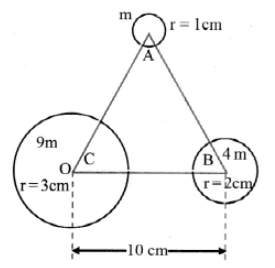
Three thin walled uniform hollow spheres of radii $1 \ cm, 2 \ cm$ and $3 \ cm$ are so located that their centres are on the three vertices of an equilateral triangle$\text{ABC}$ having each side $10 \ cm.$ Determine centre of mass of the systemImage
A book with many printing errors contains four different formulae for the displacement $y$ of a particle undergoing a certain periodic function:
$i) \ y = a \sin \frac{2 \pi t}{T}$
$ii) \ y=a \sin v t$
$iii) \ y=\frac{a}{T} \sin \frac{t}{a}$
$iv) \  y =\frac{a}{\sqrt{2}}\left[\sin \frac{2 \pi t}{T}+\cos \frac{2 \pi t}{T}\right]$
Here, $a$ is maximum displacement of particle, $y$ is speed of particle, $T$ is time period of motion. Rule out the wrong formulae on dimensional grounds.
A shell of mass $3 \ kg$ is dropped from some height. After falling freely for $2$ seconds, it explodes into two fragments of masses $2 \ kg$ and $1 \ kg.$ Kinetic energy provided by the explosion is $300 J.$ Using $g = 10 \ m/s^2,$ calculate velocities of the fragments. Justify your answer if you have more than one options.
A ball of mass $100\ g$ dropped on the ground from $5\ m$ bounces repeatedly. During every bounce $64 \%$ of the potential energy is converted into kinetic energy. Calculate the following:
(a) Coefficient of restitution.
(b) Speed with which the ball comes up from the ground after third bounce.
(c) Impulse given by the ball to the ground during this bounce.
(d) Average force exerted by the ground if this impact lasts for $250\ ms$.
(e) Average pressure exerted by the ball on the ground during this impact if contact area of the ball is $0.5\ cm^2$.
[Ans: $0.8, 5.12 m/s, 1.152N s, 4.608 N, 9.216 \times 104 N/m^2$]