Question
Explain how common size statements are prepared giving an example.

Answer

The two Common Size Statements that are most commonly prepared are as follows.
  1. Common Size Balance Sheet.
  2. Common Size Income Statements.
Common Size Statement is prepared in a columnar form for analysis. In a Common Size Statement each item of the financial statements is compared to a common item. The analyses based on these statements are commonly known as Vertical Analysis.
The following are the columns prepared in a Common Size Statement.
  • Particulars Column: This column shows the various financial items under their respective heads.
  • Amount Columns: These columns depict the amount of each item, sub-totals and the gross total of a particular year.
  • Percentage or Ratio Columns: These columns show the proportion of each item to the common item either in terms of percentage or ratio.
The Common Size Statements can be presented in the following two ways.
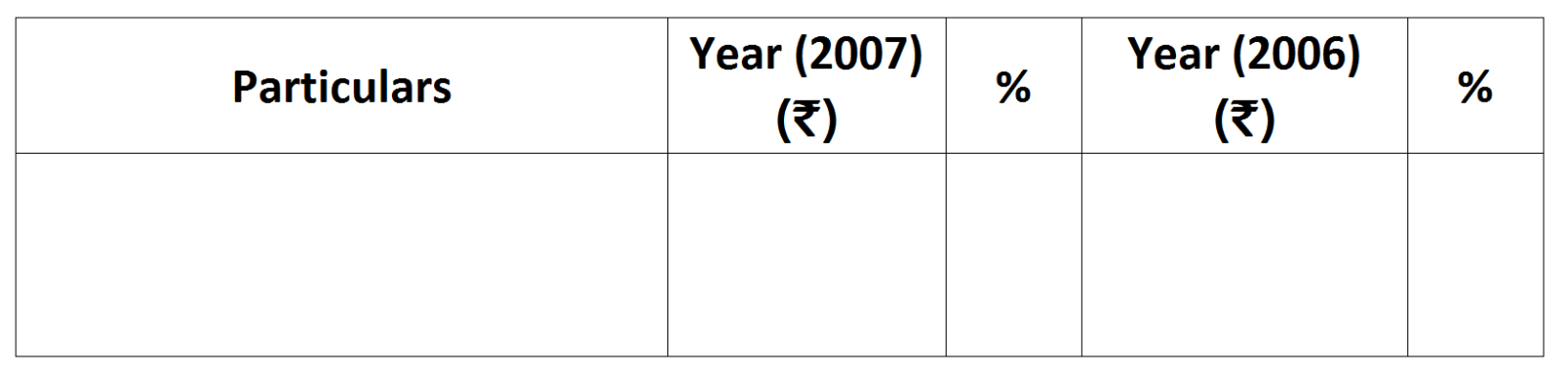
Method 1:
Percentage Column is shown beside the Amount Column of the year to which percentage column belongs.

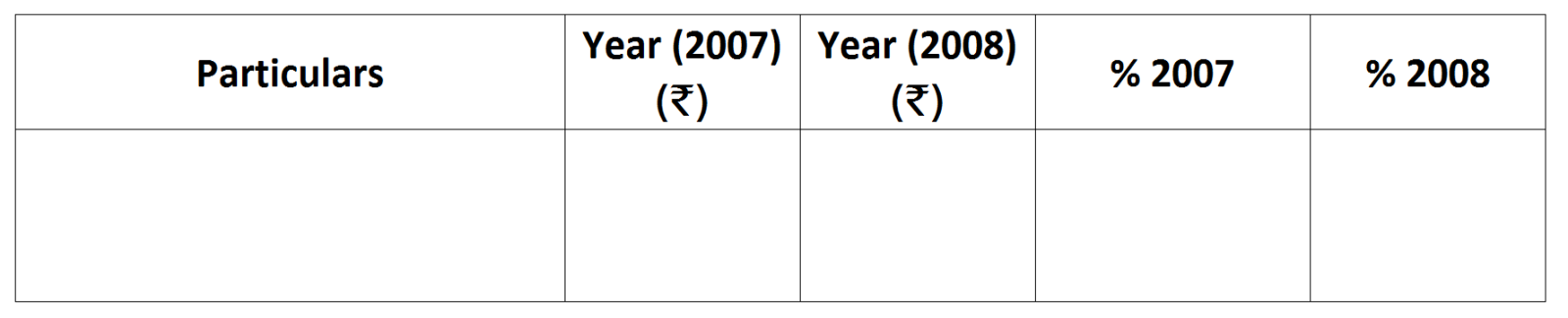
Method 2
Amount Columns are shown first and their percentage columns are shown after the Amount Columns.

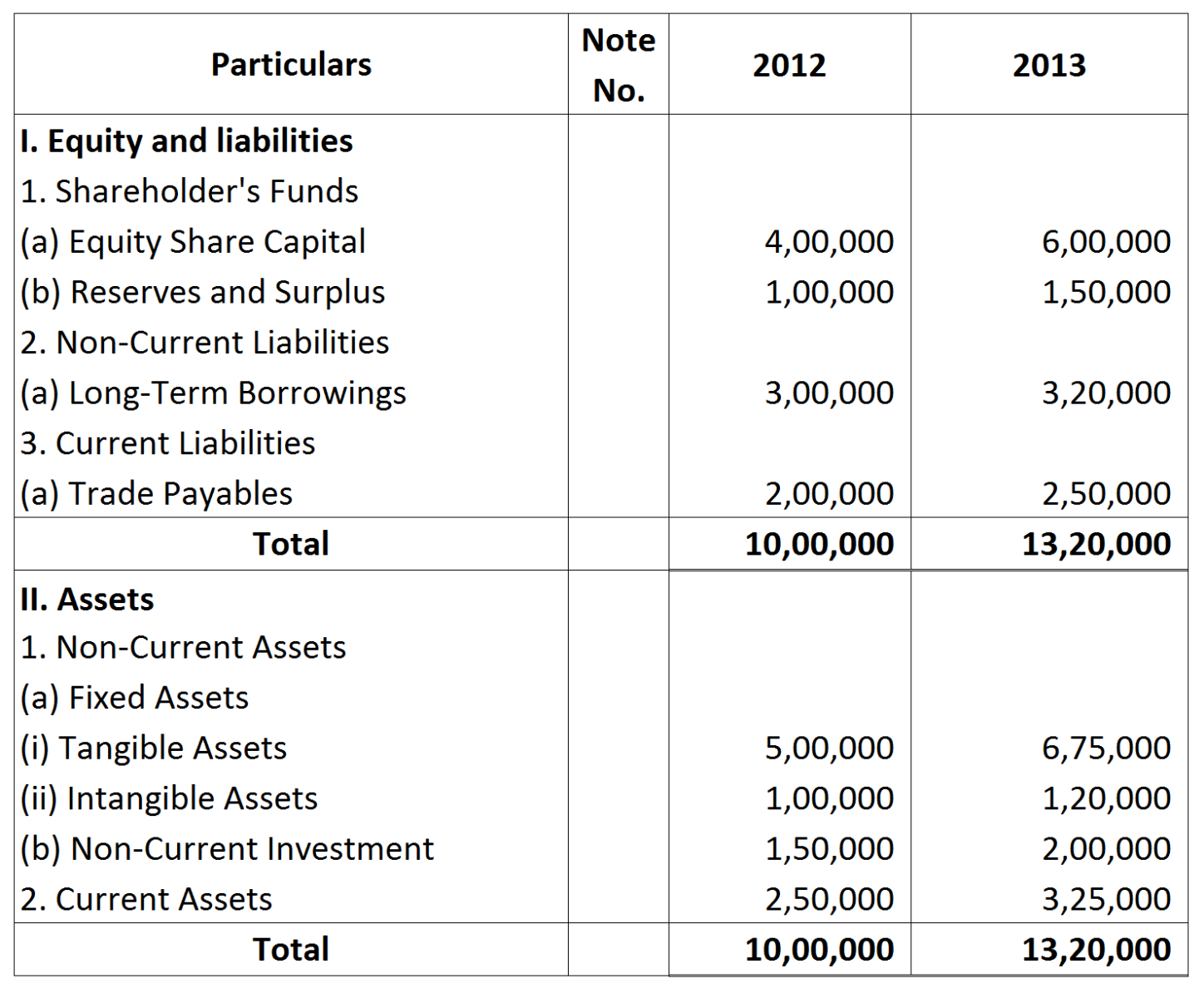
The preparation of the Common Size Statements can be better understood by the help of the following example.


Working Note:
Percentage (Previous Year) $=\frac{\text{Previous Year Absolute Figure}}{\text{Balance Sheet Total of Previous Year}}\times100$
Percentage (Current Year) $=\frac{\text{Current Year Absolute Figure}}{\text{Balance Sheet Total of Previous Year}}\times100$
For example,
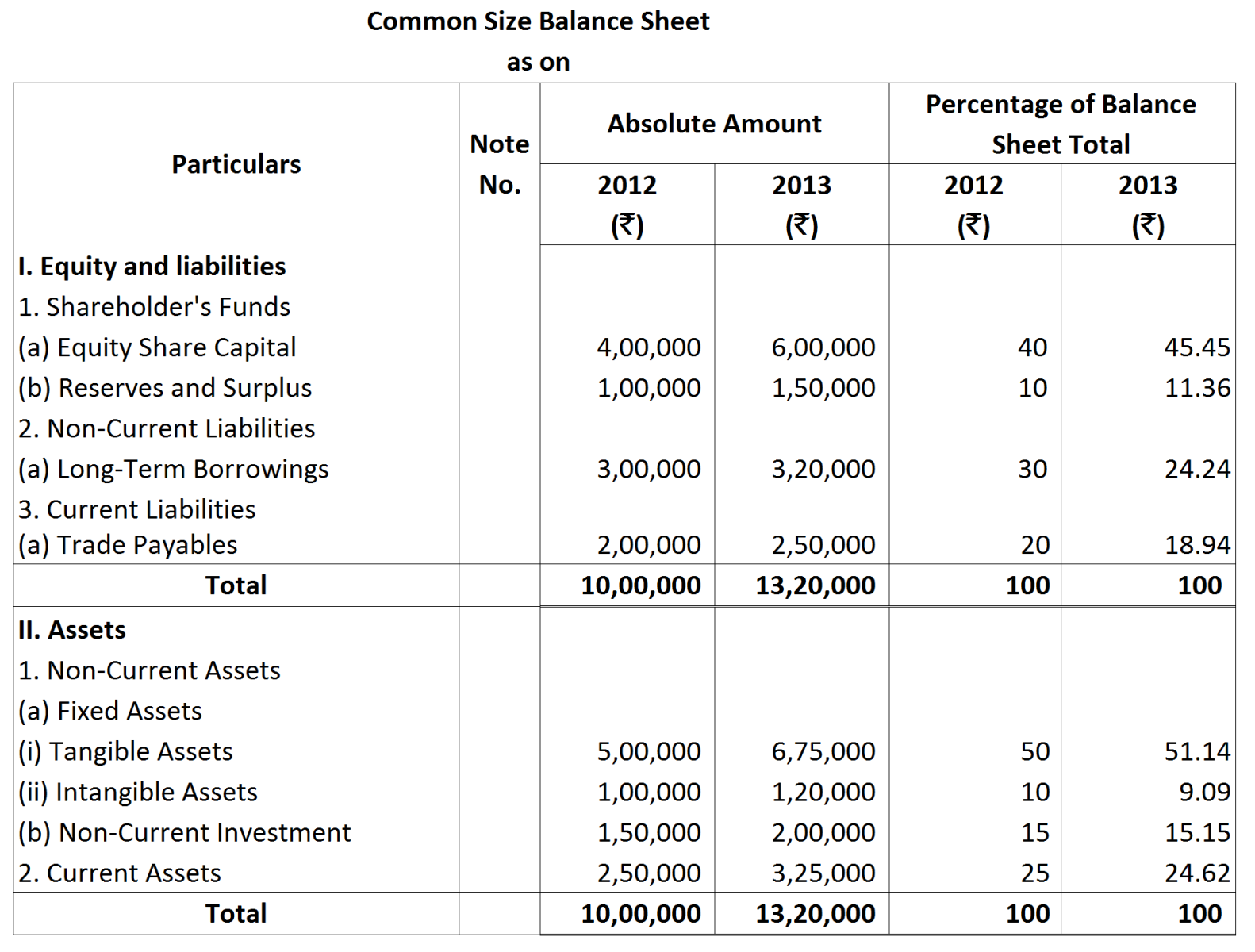
Percentage of Equity Share Capital (Previous Year) $=\frac{\text{4,00,000}}{\text{10,00,000}}\times100=40\%$
Percentage of Equity Share Capital (Current Year) $=\frac{\text{6,00,000}}{\text{13,20,000}}\times100=45.45\%$
Preparation
Step 1: Title of the Common Size Statement, i.e. ‘Common Size Balance Sheet’ is written on the top of the statement.
Step 2: In the ‘Particulars’ column, the various items of the Balance Sheet are shown under the headings of ‘Assets’ and ‘Equity and Liabilities’.
Step 3: In the ‘Amount’ column, amount of the items are shown in the ‘Year’ column to which they belong
Step 4: The Assets and Liabilities are totaled and are shown separately for each year.
Step 5: In the ‘Percentage’ column, the percentage of each item in comparison to the Total of Balance Sheet are shown.

Need a full question paper?

Generate a complete, print-ready paper with questions like this in minutes — across 16+ boards, with answer keys.

Start Generating Free

Similar questions

Total Debt ₹ 15,00,000; Current Liabilities ₹ 5,00,000; Capital Employed ₹ 15,00,000. Calculate Total Assets to Debt Ratio.
Revenue from Operations, Cash Sales ₹ 4,00,000; Credit Sales ₹ 1,00,000; Gross Profit ₹ 1,00,000 Office and Selling Expenses ₹ 50,000. Calculate Operating Ratio.
Current Ratio 2.4; Current Assets ₹ 1,81, 10,400 Inventories ₹ 79,23,300. Calculate the Liquid Ratio.
Identify which of the following items will be shown in the Notes to Accounts on 'Other Expenses':
  1. Consumption of Loose Tools.
  2. Staff Welfare Expenses.
  3. Wages.
  4. Courier Expenses.
  5. Carriage Outwards.
  6. Discount Allowed.
  7. Bank Charges.
  8. Rent for warehouse.
  9. Depreciation on Machinery.
  10. Gratuity paid.
  11. Goodwill written off.
From the following information, calculate interest coverage ratio and give your comments also:
A firm had current assets of ₹ 7,20,000. It then purchased goods for ₹ 30,000 on credit. After this purchase, the current ratio was 3 : 1. Ascertain the amount of Current Liabilities and Working Capital after the purchase
Comparison with the help of ratios is not possible if different firms follow different accounting policies.'' Comment.
Z Ltd. purchased machinery from K Ltd. Z Ltd. paid K Ltd as follows:
  1. By issuing 5,000 equity shares of ₹ 10 each at a premium of 30%.
  2. By issuing 1000, 8% Debentures of ₹ 100 each at a discount of 10%.
  3. Balance by giving a promissory note of ₹ 48,000 payable after two months.
Pass necessary journal entries for the purchase of machinery and payment to K Ltd. in the books of Z Ltd.
Net Profit before Interest and Tax ₹ 6,00,000; Net Fixed Assets ₹ 20,00,000; Net Working Capital ₹ 10,00,000; Current Assets ₹ 11,00,000. Calculate Return on Investment.
MN Ltd. has an authorised capital of ₹ 50,00,000 divided into equity shares of ₹ 10 each. The company invited applications for 3,00,000 shares. Applications for 2,75,000 shares were received. All calls were made and were duly received except the final call of ₹ 3 per share on 5,000 shares. 4,000 of the shares on which the final call was not received were forfeited. Show how Share Capital will appear in the Balance Sheet of the company. Also prepare notes to accounts.