Rajasthan BoardEnglish MediumSTD 12 SciencePhysicsELECTROSTATIC POTENTIAL AND CAPACITANCE2 Marks
Question
Explain how does the polarized dielectric modify the original external field inside it ?
✓
Answer
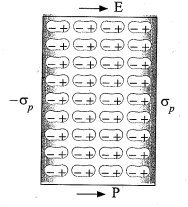
→As shown in the figure, consider a rectangular (/ cuboid) dielectric slab placed in a uniform external field $\overrightarrow{ E _0}$. →Due to this, the dipole moments are aligned almost parallel to $\overrightarrow{ E _0}$.
→The situation shown in the figure is an ideal situation, at 0K (zero kelvin) temperature, The external field causes almost uniform polarization $\overrightarrow{ P }$ of the dielectric, Thus every volume element $\Delta V$ of the slab has a dipole moment $\overrightarrow{ P } \Delta V$. →Inside the dielectric, the net charge inside the volume element $\Delta V$ is zero. This is because the positive charge of one dipole sits close to and hence cancels out the effect of the negative charge of the neighbouring dipole. However, at the surface of the dielectric net, surface density is not zero because as shown in the figure, the positive ends of the dipoles remain unneutralized at the right surface and the negative ends at the left surface. These unbalanced charges are the induced charges due to the external electric field. Therefore, there is some net surface charge density on the surface of the dielectric. →The induced electric charge is also known as bound charge. →Thus the polarized dielectric is equivalent to two charged surfaces with induced surface charge densities, say $\sigma_p$ and $-\sigma_p$. →The field produced by these surface charges opposes the external electric field. The total field in the dielectric is, there by, reduced.
Need a full question paper?
Generate a complete, print-ready paper with questions like this in minutes — across 16+ boards, with answer keys.