Question
Explain how increasing population is responsible for depletion of water table.

Answer

Increasing population creates demand for construction of houses, shops, offices, roads and pavements. This decreases the open areas like parks, and playgrounds. This, in turn, decreases the seepage of rainwater into the ground. A cemented floor does not allow water to seep in easily, while in a grass lawn water seeps through in no time. Moreover a huge amount of water is required for construction work. Often groundwater is used for this purpose. So, on the one hand we are consuming more groundwater, and on the other we are allowing lesser water to seep into the ground. This results in depletion of water table. In fact, the water table in some parts of many cities has gone down to alarmingly low levels

Need a full question paper?

Generate a complete, print-ready paper with questions like this in minutes — across 16+ boards, with answer keys.

Start Generating Free

Similar questions

Insects are called agents of pollination. How do they aid in process of pollination?
Explain form and function of urinary system in man$?$
Read the passage and answer the questions :
Tanya connects an LED across a battery but it does not glow. She changes the direction and it works.
Q.1. Why did not the LED glow the first time?
(a) Broken battery$\quad$(b) Reverse connection
(c) High voltage$\quad$(d) Weak wire
Q.2. What nature does this show about LED?
(a) Can glow either way$\quad$(b) Needs heat
(c) Works only in one direction
(d) Emits heat
Q.3. Which wire is the positive terminal of the LED?
(a) Longer wire$\quad$(b) Shorter wire
(c) Any wire$\quad$(d) None of these
Table : Observation of shadows
ActionObservations regarding shadow
The screen is removed.Shadow cannot be seen
The object is removed.No shadow is formed
The torch is switched off.No shadow is formed
The object is moved closer to the screen, keeping the torch and the screen fixed.Shadow becomes smaller
The object is moved closer to the torch, keeping the torch and the screen fixed.Shadow becomes larger
The object is tilted, keeping the torch and the screen fixed.Shape of shadow changes
The colour of the object is changed.Colour of shadow does not change
In the summer holidays, Karan went to Rann of Kutch In Gujarat with his parents. Karan was aware that in the coastal regions of India especially in the Rann of Kutch common salt is obtained from sea water. Karan was very excited to see that place. He requested his father that he want to see the process of obtaining salt from sea. His father helped him and they went to see the place where common salt was collecting. And he also explained the whole process. Karan was very happy to see the process.
Now, answer the following questions.
(i) How the crystals of common salt obtained from sea water?
(ii) Name the process by which salt is collected from sea water?
Explain the differences between heat and temperature.
There are ten tubewells in a lane of fifty houses. What could be the long term impact on the water table$?$

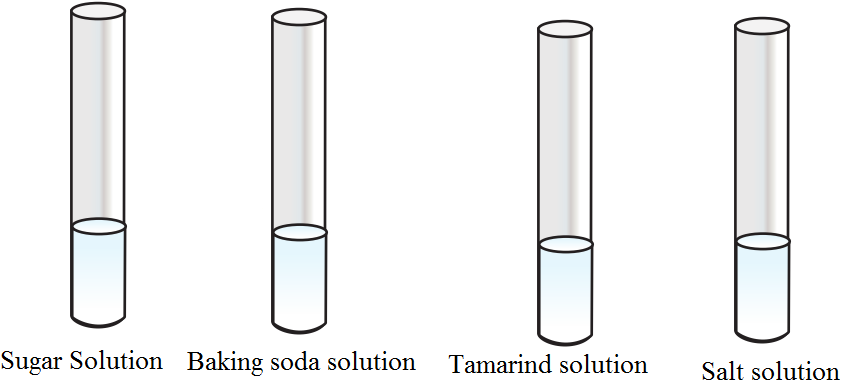
You are provided with four test tubes containing sugar solution, baking soda solution, tamarind solution, salt solution. Write down an activity to find the nature (acidic/ basic/ neutral) of each solution.
Can animals pollinate flowers? Describe the process.
Read the passage and answer the questions :
You are conducting an experiment where you add vinegar to baking soda. As soon as the two substances mix, there is a fizzing sound, and bubbles of gas begin to form, pass this gas through freshly prepared lime water. You observe that the lime water has turned milky due to formation of a precipitate.
Q.1. What type of change has occurred in this experiment?
(a) Physical change
(b) Chemical change
(c) Both physical and chemical change
(d) No change
Q.2. What is the gas that has been produced in this reaction?
(a) Oxygen$\quad$(b) Nitrogen
(c) Carbon dioxide$\quad$(d) Hydrogen
Q.3. What is the name of the white precipitate that forms in the solution?
(a) Calcium hydroxide
(b) Calcium carbonate
(c) Sodium bicarbonate
(d) Magnesium oxide