Question
Explain how the scattering experiment can be analyzed in detail from Rutherford's nuclear model.

Answer

Image

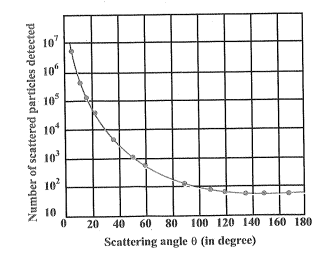
The figure shows a graph of the number of $\alpha$-particles scatterd versus the angle of scattering.
The scattering experiment can be analysed in detail from Rutherford's nuclear model. Since the gold foil is very thin, it can be assumed that $\alpha$-particles will suffer not more than one scattering during their passage through it. Hence it is sufficient to calculate the path (trajectory) of an $\alpha$-particle scattered by a single nucleus.
$\alpha$-particles are nuclei of helium atoms, so they have two units mass of positive charge $2 e$ and mass equal to that of a helium atom. The charge of the gold nucleus is Ze , where Z is the atomic number of the atom; for gold $Z =79$.
Since the nucleus of gold is about 50 times heavier than an $\alpha$-particle, it remains stationary throughout the scattering process.
The trajectory of an $\alpha$-particle can be calculated using newton's second law of motion and the coulomb's law for electrostatic force of repulsion between the $\alpha$-particle and the positively charged nucleus.
The magnitude of this force is
$F =\frac{1}{4 \pi \varepsilon_0} \frac{(2 e)( Ze )}{r^2}$
Where, $r$ is the distance between the $\alpha$-particle and the nucleus.
The force is directed along the line joining the $\alpha$-particle and the nucleus.
The magnitude and direction of the force on an $\alpha$-particle changes continuously as it moves towards and away from the nucleus.

Need a full question paper?

Generate a complete, print-ready paper with questions like this in minutes — across 16+ boards, with answer keys.
Start Generating Free

Similar questions

Define the electric resistivity of a conductor.
Plot a graph showing the variation of resistivity with temperature in the case of a (a) conductor, (b) semiconductor.
Briefly, explain, how the difference in the behaviour of the two can be explained in terms of number density of charge carriers and relaxation time.
When you lift a box from the floor and put it on an almirah the potential energy of the box increases, but there is no change in its kinetic energy. Is it a violation of conservation of energy?
Even though an electric field E exerts a force qE on a charged particle yet the electric field of an EM wave does not contribute to the radiation pressure (but transfers energy). Explain.
A cylindrical capacitor has two co-axial cylinders of length 15cm and radii 1.5cm and 1.4cm. The outer cylinder isearthed and the inner cylinder is given a charge of 3.5µC. Determine the capacitance of the system and the potential of the inner cylinder. Neglect end effects (i.e., bending of field lines at the ends).
Suppose, one wishes to construct a 1.0 farad capacitor using circular discs. If the separation between the discs be kept at 1.0mm, what would be the radius of the discs?
Why is it not possible to make permanent magnets from paramagnetic materials?
Find the radius of gyration of a circular ring of radius r about a line perpendicular to the plane of the ring and passing through one of its particles.
A monochromatic light of wavelength $\lambda$ is incident normally on a narrow slit of width ‘a’ to produce a diffraction pattern on the screen placed at a distance D from the slit. With the help of a relevant diagram, deduce the conditions for obtaining maxima and minima on the screen. Use these conditions to show that angular width of central maximum is twice the angular width of secondary maximum.
Using Gauss’s law in electrostatics, deduce an expression for electric field intensity due to a uniformly charged infinite plane sheet. If another identical sheet is placed parallel to it, show that there is no electric field in the region between the two sheets.
A convex lens of focal length 20 cm is placed coaxially with a convex mirror of radius of curvature 20 cm. The two are kept at 15 cm from each other. A point object lies 60 cm in front of the convex lens. Draw a ray diagram to show the formation of the image by the combination. Determine the nature and position of the image formed.