Maharashtra BoardEnglish MediumSTD 11 ScienceChemistryNuclear Chemistry and Radioactivity6 Marks
Question
Explain in brief: Nuclear reactor
✓
Answer
Nuclear reactor: Nuclear reactor is a device for using atomic energy in controlled manner for peaceful purposes. During nuclear fission energy is released. The released energy can be utilized to generate electricity in a nuclear reactor.
Working of a nuclear reactor:
In a nuclear reactor, $U^{235}$ or $U^{239},$ a fissionable material is stacked with heavy water $(D_2O$ deuterium oxide$)$ or graphite called moderator.
The neutrons produced in the fission pass through the moderator and lose a part of their energy. The slow neutrons produced during the process are captured which initiate new fission.
Cadmium rods are inserted in the moderator as they have ability to absorb neutrons. This controls the rate of chain reaction.
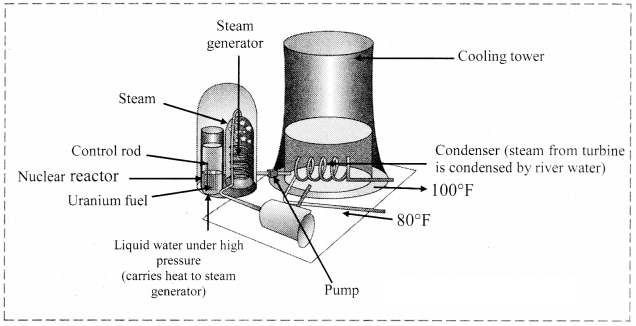
The energy released during the reaction appears as heat and removed by circulating a liquid $($coolant$).$ The coolant which has absorbed excess of heat from the reactor is passed over a heat exchanger for producing steam.
Steam is then passed through the turbines to produce electricity. Thus, the atomic energy produced with the use of fission reaction can be controlled in the nuclear reactor.
This process can be explored for peaceful purpose such as conversion of atomic energy into electrical energy which can be used for civilian purposes, ships, submarines, etc.
Note: Schematic diagram of nuclear power plant:
Need a full question paper?
Generate a complete, print-ready paper with questions like this in minutes — across 16+ boards, with answer keys.