Question
Explain J J. Thomson's plum pudding model of atom.

Answer

Experiments by physicist J.J. Thomson showed that atoms of various elements contain negatively charged constituents (electrons). which are the same for all atoms. Although the atom is electrically neutral.
Hence the atom must also have some positive charge to neutralise the negative charge of the electron.
To explain the arrangement of positive and negative charge in atom, Thomson gave an atomic model called the plum pudding model.
The first model of the atom was given by J.J. Thomson. According to this model, the positive charge of the atom is uniformly distributed throughout the volume of the atom and the negatively charged electrons are embedded in like seeds in a watermelon. This model is called plum pudding model of the atom.

Need a full question paper?

Generate a complete, print-ready paper with questions like this in minutes — across 16+ boards, with answer keys.

Start Generating Free

Similar questions

A parallel beam of monochromatic light of wavelength 663nm is incident on a totally reflecting plane mirror. The angle of incidence is 60° and the number of photons striking the mirror per second is 1.0 × 10¹⁹. Calculate the force exerted by the light beam on the mirror.
Find the angular separation between the consecutive bright fringes in a Young's double slit experiment with blue-green light of wavelength 500nm. The separation between the slits is 2.0 × 10⁻³m.
What conclusion can you draw from the following observations on a resistor made of alloy manganin?
Current A
Voltage V
Current A
Voltage V
0.2 
0.4
0.6
0.8
1.0
2.0
3.94
7.87
11.8
15.7
19.7
39.4
3.0
4.0
5.0
6.0
7.0
8.0
59.2
78.8
98.6
118.5
138.2
158.0
Why is base band signal not transmitted directly? Give any two reasons.
A book is lifted from the floor and is kept in an almirah. One person says that the potential energy of the book is increased by 20J and the other says it is increased by 30J. Is one of them necessarily wrong?
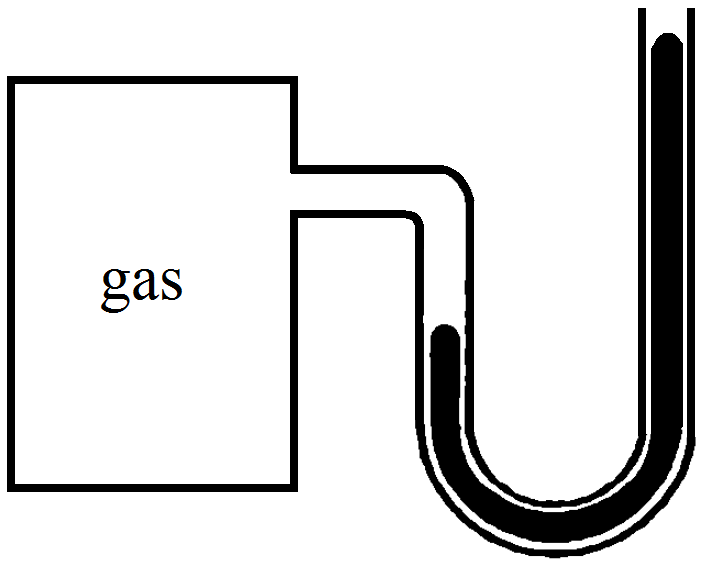
The heights of mercury surfaces in the two arms of the manometer shown in figure are 2cm and 8cm. Atmospheric pressure = 1. 01 x 105N/rn2. Find.

  1. Thepressure of the gas in the cylinder and.
  2. The pressure of mercury at the bottom of the U tube.

You are facing a circular wire carrying an electric current. The current is clockwise as seen by you. Is the field at the centre coming towards you or going away from you?
Show that the slope of p-V diagram is greater for an adiabatic process as compared to an isothermal process.
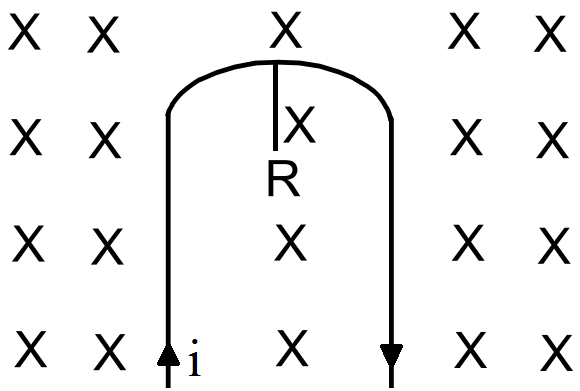
A rigid wire consists of a semi-circular portion of radius R and two straight sections The wire is partially immersed in a perpendicular magnetic field B, as shown in the figure. Find the magnetic force on the wire if it carries a current i.

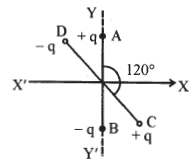
Two small identical electrical dipoles AB and CD, each of dipole moment 'p' are kept at an angle of 120o as shown in the figure. What is the resultant dipole moment of this combination? If this system is subjected to electric field ($\overrightarrow{\text{E}}$) directed along +X direction, what will be the magnitude and direction of the torque acting on this?