Question
Explain linear density, surface density and volume density for continuous charge distribution.

Answer

(1) Linear distribution of electric charge.
►If there is a continuous electric charge on a line, it is called linear distribution of electric charge.
►The electric charge per unit length on an electrically charged line is called linear density of electric charge.
►Assume there is a total charge of Q on the line length of $l$.
►Linear density of charge,
$\lambda=\frac{\text { Total electric charge }}{\text { length }}=\frac{ Q }{l}$
SI unit of linear density is $C / m$

(2) Surface distribution of charge :
If there is a continuous electric charge on a surface, it is called surface distribution of charge.
►The electric charge per unit surface is called surface density of charge.
►Assume there is a total charge of Q on the Surface of Area A,
$\therefore$ Surface density of charge,
$\sigma=\frac{\text { Total electric ch arge }}{\text { Area }}=\frac{ Q }{ A }$
►SI unit : $C / m ^2$

(3) Volume distribution of charge :
If there is a continuous electric charge on a volume, it is called volume distribution of charge.
►The electric charge per unit volume is called volume density of charge.
►Assume there is a total charge Q on the matter with volume V ,
$\therefore$ Volume density of charge
$\Omega=\frac{\text { Total ch arg } e }{\text { volume }}=\frac{ Q }{ V }$
►SI unit : C $/ m ^3$

Need a full question paper?

Generate a complete, print-ready paper with questions like this in minutes — across 16+ boards, with answer keys.
Start Generating Free

Similar questions

Calculate the de Broglie wavelength of a neutron of kinetic energy $150\ eV.$ Mass of neutron $= 1.67 \times 10^{-27}kg.$
Explain the principle and working of a cyclotron with the help of a schematic diagram. Write the expression for cyclotron frequency.
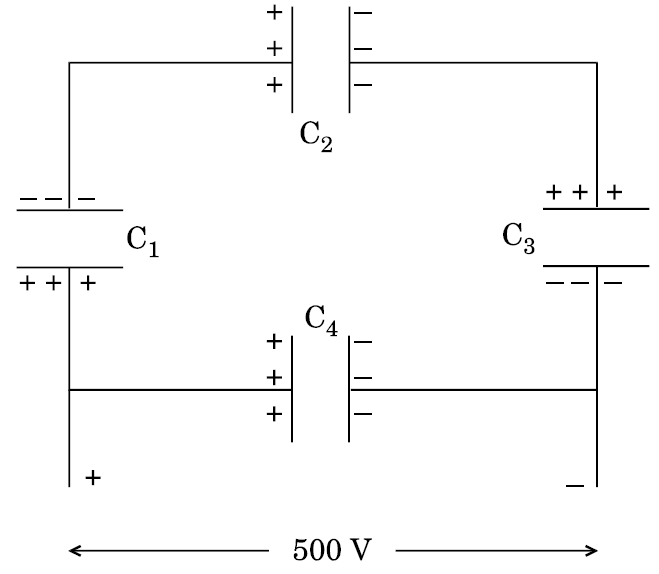
A network of four 10 $\mu$F capacitors is connected to a 500 V supply as shown in the figure. Determine the
  1. equivalent capacitance of the network and
  2. charge on each capacitor
Name the following constituent radiations of electromagnetic spectrum which
  1. produce intense heating effect.
  2. is absorbed by the ozone layer in the atmosphere.
  3. is used for studying crystal structure.
Write one more application forr each of these radiations.
A small telescope has an objective lens of focal length 144 cm and an eyepiece of focal length 6.0 cm. What is the magnifying power of the telescope? What is the separation between the objective and the eyepiece?
An object P is focused by a microscope M. A glass slab of thickness 2.1cm is introduced between P and M. If the refractive index of the slab is 1.5, by what distance should the microscope be shifted to focus the object again?
A cell of emf 'E' and internal resistance 'r' is connected across a variable load resistor R. Draw the plots of the terminal voltage V versus (i) R and (ii) the current I.
It is found that when R = 4$\Omega$, the current is 1 A and when R is increased to 9$\Omega$, the current reduces to 0.5 A. Find the values of the emf E and internal resistance r.
A small piece of wood is floating on the surface of a 2.5m deep lake. Where does the shadow form on the bottom when the sun is just setting? Refractive index of water $=\frac{4}{3}.$
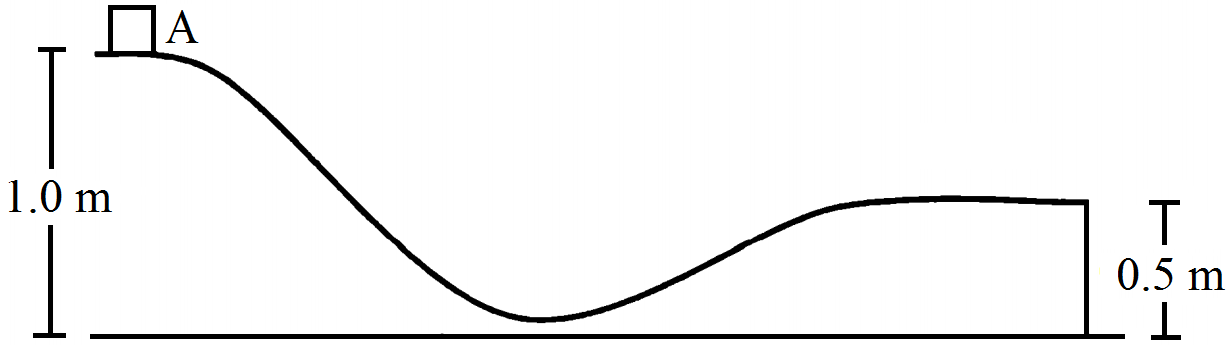
Figure shows a particle sliding on a frictionless track which terminates in a straight horizontal section. If the particle starts slipping from the point A, how far away from the track will the particle hit the ground?
A hydrogen atom initially in the ground level absorbs a photon, which excites it to the n = 4 level. Determine the wavelength and frequency of photon.