Gujarat BoardEnglish MediumSTD 12 SciencePhysicsMOVING CHARGES AND MAGNETISM3 Marks
Question
Explain Lorentz force and state its characteristics.
✓
Answer
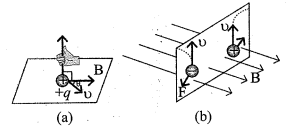
→Suppose a point charge $q$ moving with a velocity $\vec{v}$ in presence of the electric field $\overrightarrow{ E }(\vec{r})$ and the magnetic field $\overrightarrow{ B }(\vec{r})$. →Force on charge $q$ due to the electric and magnetic field. $\begin{aligned} \overrightarrow{ F } & =q[\overrightarrow{ E }(r)+(\vec{v} \times \overrightarrow{ B }(\vec{r}))] \\ \therefore \quad \overrightarrow{ F } & =q \overrightarrow{ E }(\vec{r})+q \times \times \overrightarrow{ B }) \end{aligned}$ [Here $\overrightarrow{ B }(r)=\overrightarrow{ B }$ ] Electric force $\overrightarrow{ F }_{\text {electric }}=q \cdot \overrightarrow{ E }(\vec{r})$ Magnetic force $\overrightarrow{ F }$. magnetic $=q(\overrightarrow{ v } \times \overrightarrow{ B })$ $\therefore \overrightarrow{ F }=\overrightarrow{ F }_{\text {electric }}+\overrightarrow{ F }_{\text {magnetic }}$ →The combination of electric and magnetic force here is known as Lorentz force. • Characteristics : (1) The Lorentz force depends on charge ( $q$ ), velocity ( $\vec{v}$ ) and the magnetic field $(\vec{B})$. Force on negative charge is opposite to that on a positive charge. (2) The direction of magnetic force $\vec{F}_m=q(\vec{v} \times$ $\vec{B}$ ) can be found using right hand screw rule. (3) If velocity $\vec{v}$ and the magnetic field $\vec{B}$ are parallel $(\theta=0)$ anti parallel $\left(\theta=180^{\circ}, \pi\right)$ to each other, the force becomes zero. The magnetic force is maximum when the velocity $\vec{v}$ and the magnetic field $\vec{B}$ are perpendicular to each other. (4) If charge is not moving i.e. the charge is stationary. then $\vec{v}=0$ hence the magnetic force is zero.
Need a full question paper?
Generate a complete, print-ready paper with questions like this in minutes — across 16+ boards, with answer keys.