Question
Explain magnetic properties of transition element.

Answer

→ When a magnetic field is applied to substances, mainly two types of properties magnetic behaviour are observed : diamagnetism and paramagnetism
→ Diamagnetic substances are repelled by the applied field while the paramagnetic substances are attracted.
→ Substances which are attracted very strongly are said to be ferromagnetic.
→ In fact, ferromagnetism is an extreme form of paramagnetism. Many of the transition metal ions are paramagnetic.
→ Paramagnetism arises from the presence of unpaired electrons, each such electron having a magnetic moment associated with its spin angular momentum and orbital angular momentum.
For these, the magnetic moment is determined by the number of unpaired electrons and is calculated by using the 'spin-only' formula, i.e.,
$
\mu=\sqrt{n(n+2)}
$
→ where $n=$ is the number of unpaired electrons $\mu=$ magnetic moment in units of Bohr magneton $( BM )$.
→ The magnetic moment increases with the increasing number of unpaired electrons.
Calculated and Observed Magnetic Moments (BM)
IonConfigurationUnpaired
Electron(s)
Magnetic moment
CalculatedObserved
$Sc ^{3+}$$3 d^0$000
$Ti ^{3+}$$3 d^1$11.731.75
$Ti ^{2+}$$3 d^2$22.842.76
$V ^{2+}$$3 d^3$33.873.86
$Cr ^{2+}$$3 d^4$44.904.80
$Mn ^{2+}$$3 d^5$55.925.96
$Fe ^{2+}$$3 d^6$44.905.3 – 5.5
$Co ^{2+}$$3 d^7$33.874.4 – 5.2
$Ni ^{2+}$$3 d^8$22.842.9 – 3,4
$Cu ^{2+}$$3 d^9$11.731.8 – 2.2
$Zn ^{2+}$$3 d^{10}$00

Need a full question paper?

Generate a complete, print-ready paper with questions like this in minutes — across 16+ boards, with answer keys.
Start Generating Free

Similar questions

Describe the following :
Cross adol condensation
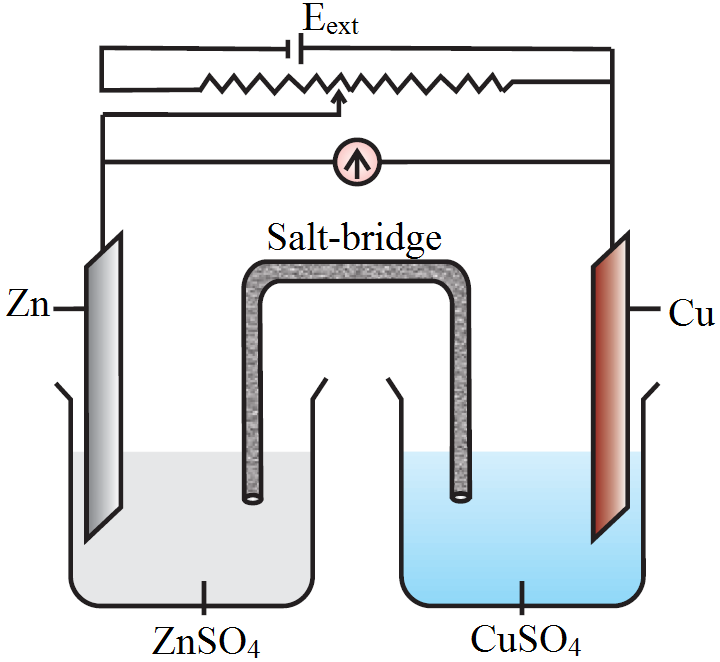
The electrochemical cell given alongside converts the chemical energy released during the redox reaction
$\text{Zn(s) + Cu}^{2+}\text{(aq)}\xrightarrow{ \ \ \ \ \ \ \ }\text{Zn}^{2+}(\text{aq) + Cu(s)}$
to electrical energy. It gives an electrical potential of $1.1V$ when concentration $Zn^{2+}$ and $Cu^{2+}$ ions is unity. State the direction of flow of current and also specify whether zinc and copper are deposited or dissolved at their respective electrodes when:
  1. An external opposite potential of less than $1.1V$ is applied.
  2. An external potential of $1.1V$ is applied.
  3. An external potential of greater than $1.1V$ is applied.
Answer the following questions.
Write about the following on protein synthesis:
  1. Name the location where protein synthesis occurs.
  2. How do 64 codons code for only 20 amino acids?
  3. Which of the two bases of the codon are more important for coding?
Give reasons for the following:
  1. Aniline does not undergo Friedal$-$Crafts reaction.
  2. $(CH_3)_2 NH$ is more basic than $(CH_3)_3 N$ in an aqueous solution.
  3. Primary amines have higher boiling point than tertiary amines.
Calculate the electrode potential of copper electrode dipped in $0.1\ce{M CuSO_4}$ solution at $298K.$ Given that $\text{E}^{\circ}_{\text{cu}^{2}+/\text{cu}}=0.34\text{V}.$
Explain measurement and calculation of resistance and conductivity of electrolytic solution.
What is meant by the chelate effect? Give an example.
Answer thefollowing:
  1. Haloalkanes easily dissolve in organic solvents,why?
  2. What is known as a racemic mixture? Give an example.
  3. Of the two bromoderivatives $,\ce{C_6H_5CH(CH_3)Br}$ and $\ce{C_6H_5CH(C_6H_5) Br},$ which one ismore reactive in $\ce{S_N1}$ substitution reaction and why?
Explain why $\ce{[Fe(H_2O)_6]^{3+}}$ has magnetic moment value of $5.92BM$ whereas $\ce{[Fe(CN)_6]^{3-}}$ has a value of only $1.74BM.$
Write the structures of the major products expected from the following reactions:
$a.$ Mononitration of $3-$methylphenol
$b.$ Dinitration of $3-$methylphenol
$c.$ Mononitration of phenyl methanoate