Question
Explain meaning of the terms compression and rarefaction in relation to a longitudinal wave.

Answer

A longitudinal wave propagates by means of compressions and rarefactions.
When a vibrating object moves forward, it pushes and compresses the air in front of it creating a region of high pressure. This region is called a compression (C), as shown in Fig. This compression starts to move away from the vibrating object. When the vibrating object moves backwards, it creates a region of low pressure called rarefaction (R), as shown in Figure .
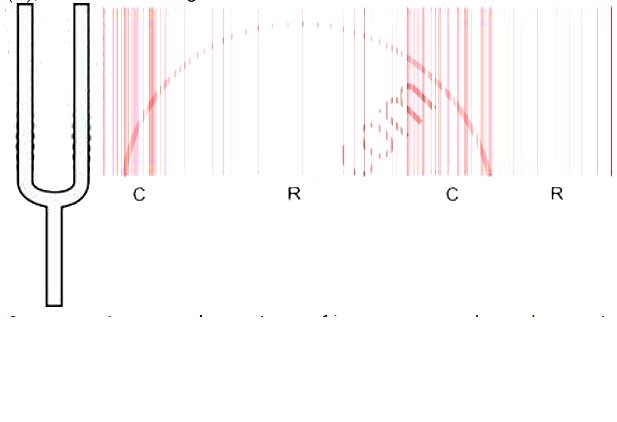
Compressions are the regions of high density where the particles of the medium come very close to each other and rarefactions are the regions of low density where the particles of the medium move away from each other.
Need a full question paper?

Generate a complete, print-ready paper with questions like this in minutes — across 16+ boards, with answer keys.

Start Generating Free

Similar questions

What do you understand by the term acceleration due to gravity? What is its value in C.G.S. and S.I. systems?
A body of volume V and density $\rho_{ s }$, floats with volume v inside a liquid of density $\rho_{ L }$. Show that $\frac{v}{V}=\frac{\rho_s}{\rho_L}$
Describe, briefly how can you calculate the value of ' $g$ ' with a simple pendulum.
A glass cylinder of length $12 \times 10^{-2} m$ and area of crosssection $5 \times 10^{-4} m^2$ has a density of $2500 kgm^{-3}$. It is immersed in a liquid of density $1500 kgm^{-3}$, such that $3 / 8$. of its length is above liquid. Find the apparent weight of glass cylinder in newtons.
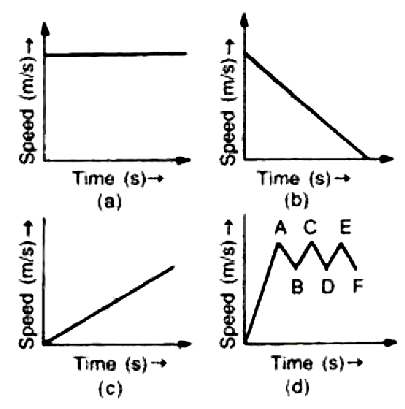
Given on th e side are a few speed - time graphs for various objects moving along a stra ight line. Refer below figure. (a), (b), (c) and (d).

Which of these graphs represent
(a) Uni form motion
(b) Motion with speed increasing
(c) Motion with speed decreasing and
(d) Motion with speed oscillating.?
How will you find the volume of a lump of salt or sugar using a graduated cylinder?
An object 1.5 cm high when placed in front of a concave . mirror, produces a virtual image 3 cm high. If the object is placed at a distance of 6 cm from the pole of the mirror, calculate:
1. the position of the image
2. the focal length of the mirror.
Draw a neat two ray diagram for the formation of images in two plane mirrors, when mirrors are
1. at right angles to each other
2. facing each other.
What is a manometer? How does it show whether the pressure inside a vessel connected to one arm of it, is lower or above the atmospheric pressure?
A micrometre screw gauge has a negative zero error of 8 divisions. While measuring the diameter of a wire the reading on main scale is 3 divisions and 24th circular scale division coincides with base line.
If the number of divisions on the main scale are 20 to a centimetre and circular scale has 50 divisions, calculate
1. pitch
2. observed diameter.
3. least count
4. corrected diameter.