Question
Explain mechanical work and how is work expressed in different situations? Explain.

Answer

SELF

Need a full question paper?

Generate a complete, print-ready paper with questions like this in minutes — across 16+ boards, with answer keys.

Start Generating Free

Similar questions

  1. How many electrons will present in sub-shell having spin quantum number value of $-\frac{1}{2}$ for n = 4?
  2. Which of the following transition will have minimum wavelength and why?

n4 → n1, n4 → n2, n2 → n1.

  1. Give the number of radial nodes for 3s and 2p orbitals.
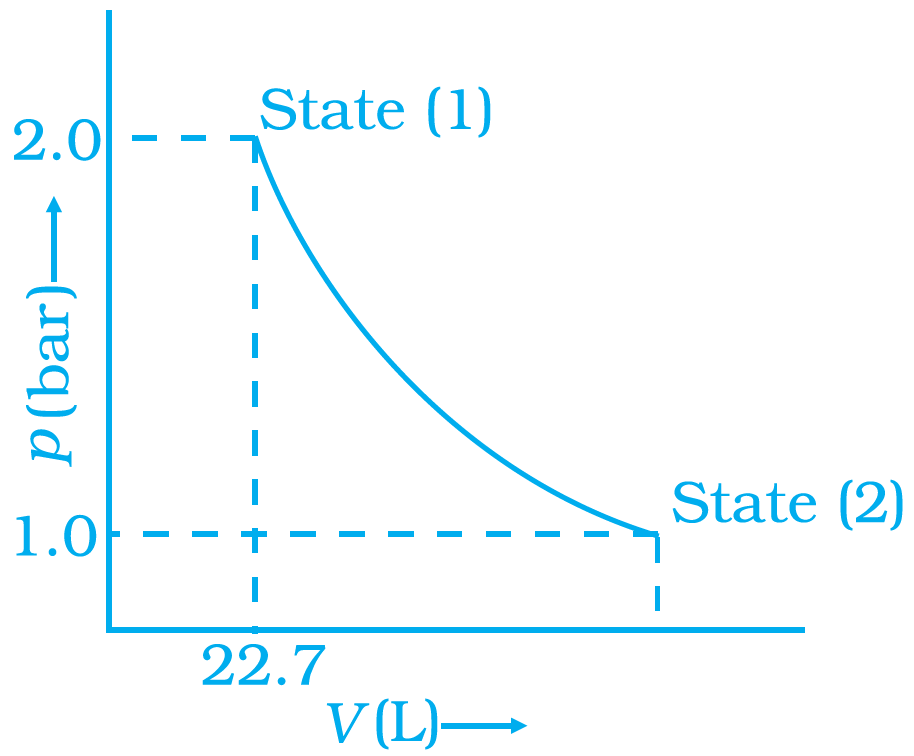
1.0 mol of a monoatomic ideal gas is expanded from state (1) to state (2) as shown in Fig. Calculate the work done for the expansion of gas from state (1) to state (2) at 298K.

The work function for caesium atom is 1.9 eV . Calculate (a) the threshold wavelength and (b) the threshold frequency of the radiation. If the caesium element is irradiated with a wavelength 500 nm , calculate the kinetic energy and the velocity of the rejected photoelectron.
In terms of period and group where would you locate the element with Z =114?
Explain the formation of a chemical bond.
Explain the following in contrast to alkynes: (i) Polymerisation (ii) Isomerisation (iii) Oxidation (iv) Ozonolysis
Explain the following :
(a) isomerisation of alkanes
(b) aromaticity
(c) thermal decomposition
For the reaction,

2A(g) + B(g) → 2D(g)

$\Delta\text{U}^\ominus=-10.5\text{kJ} \ \text{and} \ \Delta\text{S}^\ominus=-44.1\text{kJ}^{-1}.$

Calculate $\Delta\text{G}^\ominus$ for the reaction, and predict whether the reaction may occur spontaneously.

$2\text{NO}(\text{g})+\text{O}_2(\text{g})\rightleftharpoons2\text{NO}_2(\text{g});\Delta\text{H}=-17\text{KJ}$
  1. Predict the effect of an increase in concentration of NO on the equilibrium concentration of NO2.
  2. Predict the effect of pressure decrease as a result of increased volume on the equilibrium concentration of NO2.
The reactant which is entirely consumed in reaction is known as limiting reagent. In the reaction 2A + 4B → 3C + 4D, when 5 moles of A react with 6 moles of B, then
  1. Which is the limiting reagent?
  2. Calculate the amount of C formed?