Question
Explain Mutualism as a population interaction with suitable examples.###Explain Mutualism with examples

Answer

→ This interaction confers benefits on both the interacting species.
Lichen : It is a mutualistic relationship between a fungus & photosynthesizing algae or cyanobacteria.
Mycorrhizae : Associations between fungi & the roots of higher plants. The fungi help the plant in the absorption of essential nutrients from the soil while the plant provides the fungi with carbohydrates.
Mutualism between plant & animal through pollination and seed dispersion :
Examples :
(1) Fig trees & wasps : The fig species is pollinated only by its 'partner' wasp species.
→ Female wasp pollinates the fig inflorescence  while searching for suitable egg-laying sites in fruits.
→ The fig offers the wasp some developing seeds, as food for the wasp larvae.
(2) Orchids : show diversity of floral patterns. They can attract the right pollinator insect (bees & bumblebees) to ensure pollination. Not all orchids offer rewards.
(3) 'Sexual deceit of Ophrys :  (Mediterranean orchid). One petal of its flower resembles female bee in size, colour & markings.
→ So male bee 'pseudocopulates' with the flower and is dusted with pollen. When this bee 'pseudocopulates' with another flower, it transfers pollen to it.
→ If the female bee's colour patterns change. slightly during evolution, pollination success will be reduced unless the orchid flower co- evolves to maintain the resemblance of its petal to the female bee.
Need a full question paper?

Generate a complete, print-ready paper with questions like this in minutes — across 16+ boards, with answer keys.

Start Generating Free

Similar questions

Describe the process of DNA Fingerprinting in detail.
Describe Sex Determination in honey bee with diagram.
Read the following and answer any four questions from (i) to (v) given below:

Oogenesis is the process of formation of ovum in ovaries. It consists of three phases : multiplication, growth and maturation. Oogenesis is controlled by hormones GnRH, LH, FSH. GnRH secreted by the hypothalamus stimulates the anterior lobe of pituitary gland to secrete LH and FSH.

  1. What is the function of hormone FSH?
  1. It inhibits the formation of estrogen.
  2. It induces the release of secondary oocyte.
  3. It stimulates the growth of Graafian follicles.
  4. It causes ovulation.
  1. Which hormone induces the rupture of the mature Graafian follicle?
  1. Follicle stimulating hormone.
  2. Gonadotropin releasing hormone.
  3. Progesterone.
  4. Luteinising hormone.
  1. Which cell division is involved in the formation of secondary oocyte?
  1. Mitosis.
  2. Meiosis I.
  3. Amitosis.
  4. Meiosis II.
  1. Identify the function(s) of LH.
  1. Release of secondary oocyte from Graafian follicle.
  2. Stimulates corpus luteum to secrete progesterone.
  3. Stimulates estrogen formation.
  4. Promotes development of egg to form secondary oocyte.
  1. (A) and (B) only.
  2. (B) and (C) only.
  3. (A), (C) and (D) only.
  4. (B) only.
  1. Assertion: The increase in progesterone level exerts positive feedback on GnRH.

Reason: The rising level of progesterone stimulate production of FSH and LH.

  1. Both assertion and reason are true, and reason is the correct explanation of assertion.
  2. Both assertion and reason are true, but reason is not the correct explanation of assertion.
  3. Assertion is true, but reason is false.
  4. Both assertion and reason are false.
Explain: Acquired Immunity.
Suggest some methods to assist infertile couples to have children.
Draw a schematic diagram of typical anatropous ovule and describe structure of megasporangium in detail.###With a neat, labelled diagram, describe the parts of a typical angiosperm ovule.
Read the following and answer any four questions from (i) to (v) given below:

Non-native or alien species are often introduced in advertently for their economic and other uses. They often become invasive and drive away the local species. Exotic species have proved harmful to both aquatic and terrestrial ecosystems. For example, water hyacinth (Eichhornia crassipes) was introduced in Indian waters to reduce pollution. It was clogged water bodies including wetlands at many places resulting in death of several aquatic plants and animals.

  1. Island water ecosystem are the most vulnerable due to:
  1. Small size.
  2. Small number of species.
  3. Increases reproductive capacity.
  4. Both (a) and (b).
  1. Which of the following is not an alien species?
  1. Lantana camara.
  2. Periplaneta americana.
  3. Nile Perch.
  4. Yucca moth.
  1. Second major cause of species extinction is:
  1. Habitat loss and fragmentation.
  2. Over exploitation.
  3. Alien species invasion.
  4. Co-extinction.
  1. Assertion: Eichhomia crassipes drains off oxygen from water and can be seen growing in standing water.

Reason: Eichhornia crassipes is an indigenous species of India.

  1. Both assertion and reason are true and reason is the correct explanation of assertion.
  2. Both assertion and reason are true but reason is not the correct explanation of assertion.
  3. Assertion is true but reason is false.
  4. Both assertion and reason are false.
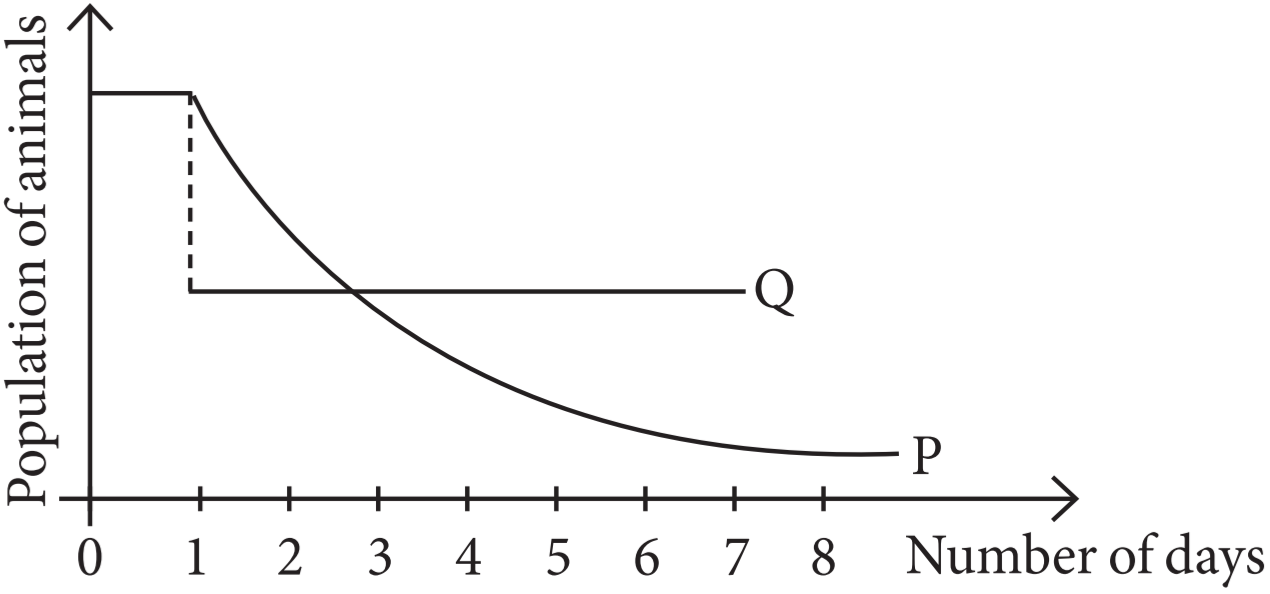
  1. The population of species Pin a certain conununity was constant until a population species Q from a distant land was subsequently introduced into that community. The interaction between the two populations is reflected in the graph below.

What could be the possible reason for the decrease in the population of species P over a number of days?

  1. Species Q is a predator of species P.
  2. Species Q is a prey species which wiped out the population of species P.
  3. Species P and Q compete for space but feeds on different food.
  4. None of these.
Read the following text carefully and answer the questions that follow:
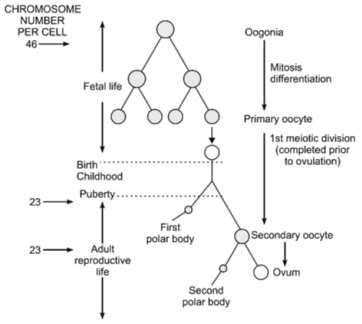
The process of formation of a mature female gamete is called oogenesis which is markedly different from spermatogenesis. A schematic representation of Oogenesis is shown below study the flow chart carefully.

Image
i. How is a primary oocyte different from a secondary oocyte? (1)
ii. Mention the changes taking place during the transition of a secondary follicle to Graafian follicle in the oogonia. (1)
iii. How many primary follicles are left in each ovary in a human female at puberty? (2)
OR
What happen to graafuan follicle after ovulation? (2)
Define ecological pyramids and describe with examples, pyramids of number and biomass.
Read the following and answer any four questions from S(i) to S(v) given below:

Rajat is a student of biotechnology. His professor tells him that for transformation with recombinant DNA the bacterial cells must be made capable of taking up DNA as DNA do not pass through membrane. While doing experiment in the lab, Rajat noticed that bacterial cells were not taking up the foreign DNA even after treating it with sodium ion. He asked his professor, the reason behind this. His professor explained that he should check the valency and charge of the ion that he is using for the treatment.

  1. It is difficult for DNA to pass through the membrane as
  1. It is a hydrophilic molecule.
  2. It is a hydrophobic molecule.
  3. It is a circular molecule.
  4. It changes its shape when it comes in contact with host cell.
  1. What type of ions are used for DNA mediated gene transfers?
  1. Divalent anions.
  2. Divalent cations.
  3. Monovalent cations.
  4. Monovalent anions.
  1. rDNA stands for,
  1. reduced DNA
  2. red DNA
  3. recombinant DNA
  4. related DNA.
  1. Which of the following statements with regard to DNA is correct?
  1. DNA is a positively charged molecule having two polynucleotide chains.
  2. Nitrogen bases of two polynucleotide chain form complementary pairs, i.e., A opposite G and T opposite C.
  3. Backbone of DNA chain is built up of alternate deoxyribose sugar and phosphate group.
  4. Both (a) and (c)
  1. Assertion: Competent host is essential for transformation with rDNA.

Reason: Transfer of DNA in a prokaryotic cell is called transfection.

  1. Both assertion and reason are true and reason is the correct explanation of assertion.
  2. Both assertion and reason are true but reason is not the correct explanation of assertion.
  3. Assertion is true but reason is false.
  4. Both assertion and reason are false.