Question
Explain mutualism with the help of any two examples. How is it different from commensalism?

Answer

Mutualism is a kind of population interaction in which both the participating species derive a benefit from each other’s presence. Examples of mutualism are given below:
  1. Associations between fungi and plants, called mycorrhizae—The plants is benefitted by essential soil nutrients that the fungus absorbs and transfers to the plant through its roots. The fungus, in turn, derives the benefits of receiving energy-yielding carbohydrates from the plant.
  2. Pollination- The flowers of a plant provide sweet, mucilaginous nectar to birds or insects in return for getting help from the birds or insets in spreading their pollen grains onto other flowers. The plant-pollinator pair often undergoes co-evolution to safeguard against the use of the nectar by other non-useful organisms.
Mutualisms differs from commensalism in that the latter provides a benefit to just one of the participating species the benefitted species being called a commensal.

Need a full question paper?

Generate a complete, print-ready paper with questions like this in minutes — across 16+ boards, with answer keys.
Start Generating Free

Similar questions

What are transgenic plants? Give some example.
  1. What is an allergic reaction?
  2. Name any two drugs used to quickly reduce the symptoms of allergy.
  3. Why do more and more children in metro cities of India suffer from allergies and asthma?
  1. What is meant by ecological succession? Explain how it occurs.
  2. What properties distinguish a pioneer community from a climax community?
Differentiate between external fertilisation and internal fertilisation with an example for each.
  1. HIV and Hepatitis B are STDs. Mention any two other ways by which they can be transmitted to a healthy person.
  2. Why is early detection of STD essential? What can it lead to otherwise?
Differentiate between gametogenesis from embryogenesis.
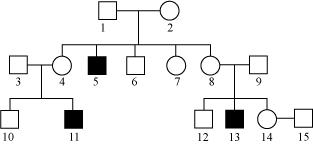
Haemophilia is a sex-linked recessive disorder of humans. The pedigree chart given below shows the inheritance of haemophilia in one family. Study the pattern of inheritance and answer the questions given.
  1. Give all the possible genotypes of the members 4; 5 and 6 in the pedigree chart.
  2. A blood test shows that the individual 14 is a carrier of haemophilia. The member numbered 15 has recently married the member numbered 14. What is the probability that their first child will be a haemophilia male?
Your school has been selected by the Department of Education to organise and host an interschool seminar on "Reproductive Health - Problems and Practices". However, many parents are reluctant to permit their wards to attend it. Their argument is that the topic is "too embarrassing."
Put forth four arguments with appropriate reasons and explanation to justify the topic to be very essential and timely.
Name the genes responsible for making Bt cotton plants resistant to bollworm attack. How do such plants attain resistance against bollworm attacks? Explain.
Explain Miller's experiment on origin of life with diagram.