Question
Explain nitration of phenol in detail.

Answer

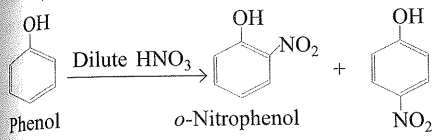
→ Nitration: With dilute nitric acid at low temperature (298 K), phenol yields a mixture of ortho and para nitrophenols.
Image
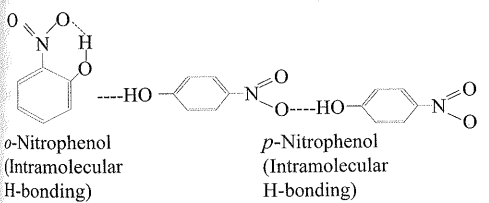
→ The ortho and para isomers can be separated by steam distillation. o-Nitrophenol is steam volatile due to intramolecular hydrogen bonding while p-nitrophenol is less volatile due to intermolecular hydrogen bonding which causes the association of molecules.
Image
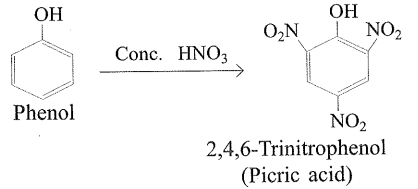
→ With concentrated nitric acid, phenol is converted to 2,4,6-trinitrophenol. The product is commonly known as picric acid. The yield of the reaction product is poor.
Image
→ Nowadays picric acid is prepared by treating phenol first with concentrated sulphuric acid which converts into phenol-2,4-disulphonic acid, and then with concentrated nitric acid to get 2,4,6-trinitrophenol.

Need a full question paper?

Generate a complete, print-ready paper with questions like this in minutes — across 16+ boards, with answer keys.

Start Generating Free

Similar questions

Give reasons for the following $:$
  1. Acetylation of aniline reduces its activation effect.
  2. $\ce{CH_3NH_2}$ is more basic than $\ce{C_6H_5NH_2}.$
  3. Although $-\ce{NH2}$ is $o/p$ directing group, yet aniline on nitration gives a significant amount of $m-$nitroaniline.
Give reasons for the following$:$
  1. The transition metals generally form coloured compounds.
  2. $E^\circ$ value for $\ce{(Mn^{3+}|Mn^{2+})}$ is highly positive than that for $\ce{(Cr^{3+}|Cr^{2+})}$ couple.
  3. The chemistry of actinoids elements is not so smooth as that of the lanthanoids.
Complete the following giving the structures of major organic products.
$(\text{CH}_3)_3-\text{C}-\text{CH}_2-\text{Br}\xrightarrow[\Delta]{\text{C}_2\text{H}_5\text{ONa}/\text{C}_2\text{H}_5\text{OH}}\ ........$
Give the reaction of chlorobenzene with Hydroxyl group.
Calculate the magnetic moment of a divalent ion in aqueous solution if its atomic number is $25.$
$i.$ Determine the units of rate constant for first and zero order reaction.
$ii.$ Show that time required for the completion of $99\%$ of the first order reaction is twice the $90\%$ of completion of the reaction.
What happens when?
(i) Chlorobenzene is allowed to react with $ Cl_2/FeCl_3 $.
(ii) Ethyl chloride is reacted with $ AgNO_2 $.
(iii) 2-Bromo-pentane is interacted with alcoholic KOH.
Give reasons for the following$:$
  1. Ethyl iodide undergoes $S_N2$ reaction faster than ethyl bromide.
  2. $(\pm) 2-$Butanol is optically inactive.
  3. $C-X$ bond length in halobenzene is smaller than $C-X$ bond length in $CH_3-X.$
Explain Halogenation, Nitration, Sulphonation and Friedel crafts reaction of chlorobenzene.
Explain Finkelstein and Swarts reaction.Explain preparation of haloalkane by halogen exchange method.