Question
Explain non-cylic photophosphorylation in plants. Why is this process called so?OR
Where does non-cyclic photophosphorylation take place? Describe this process. Why is this process called so?
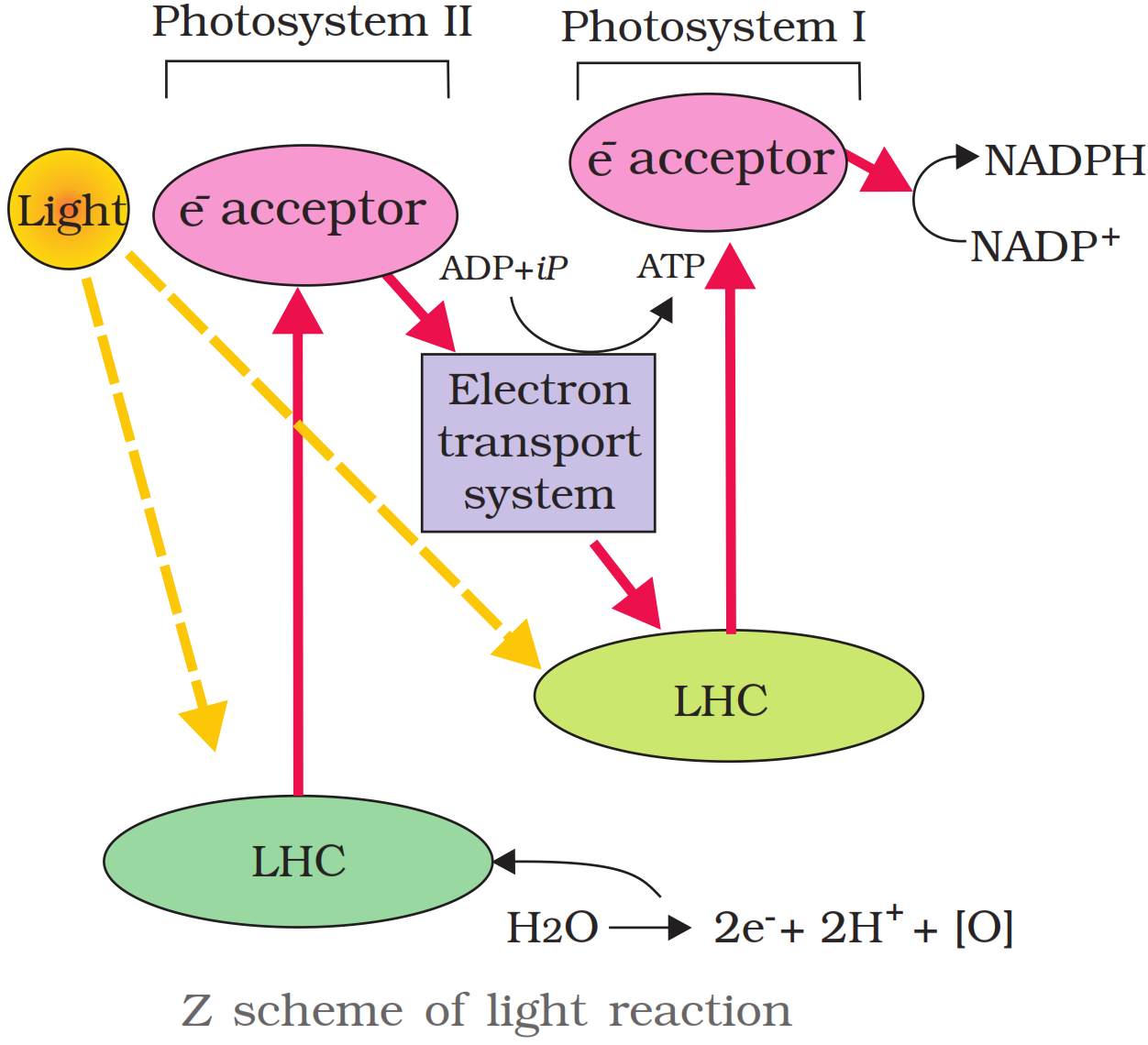
Answer

  • Non-cyclic photophosphorylation occurs in lamellae of grana.
  • It begins with the absorption of light by $P_{680}$ in PS II.
  • The electrons become excited and jump over into an orbit farther away from the atomic nucleus.
  • These electrons are picked up by the primary electron acceptor, which passes them into an electron transport system, consisting of cytochromes.
  • These electrons are not used by any component of the ETS, but are transferred to PS I.
  • Simultaneously, light of wavelength 700 nm is absorbed by PS I, which becomes excited and releases electrons.
  • These electrons are transferred to another electron acceptor, from where they are transferred to $NADP^+; NADP^+ $ is reduced (along with the protons formed by photolysis) to $NADPH + H^+$.
  • Both ATP and NADPH are formed during this electron flow.
  • Since the electrons lost from PS II do not return to PS II, but are replaced by those from water, the process is called non-cyclic.
  •  

Need a full question paper?

Generate a complete, print-ready paper with questions like this in minutes — across 16+ boards, with answer keys.

Start Generating Free