Question
Explain oxidation and reduction reactions of carbonyl compounds.

Answer

self

Need a full question paper?

Generate a complete, print-ready paper with questions like this in minutes — across 16+ boards, with answer keys.

Start Generating Free

Similar questions

Match the coordination compounds given in Column I with the central metal atoms given in Column II and assign the correct code:
 
Column I (Coordination Compound)
 
Column II (Central metal atom)
a.
Chlorophyll
1.
Rhodium
b.
Blood pigment
2.
Cobalt
c.
Wilkinson catalyst
3.
Calcium
d.
Vitamin $B_{12}$
4.
Iron
 
 
5.
Magnesium
Code:
  1. A (5), B (4), C (1), D (2).
  2. A (3), B (4), C (5), D (1).
  3. A (4), B (3), C (2), D (1).
  4. A (3), B (4), C (1), D (2).
(a) What is van't Hoff factor? Explain.
(b) Write the equation of molecular number properties including van't Hoff factor.
What are the similarities between lanthanoids and actinoids?
A hydrocarbon 'A', $\left(\mathrm{C}_4 \mathrm{H}_8\right)$ on reaction with HCl gives a compound ' B ', $\left(\mathrm{C}_4 \mathrm{H}_9 \mathrm{Cl}\right)$, which on reaction with 1 mol of $\mathrm{NH}_3$ gives compound ' C ', ( $\left.\mathrm{C}_4 \mathrm{H}_{11} \mathrm{~N}\right)$. On reacting with $\mathrm{NaNO}_2$ and HCl followed by treatment with water, compound ' C ' yields an optically active alcohol,'D'. Ozonolysis of 'A' gives 2 mols of acetaldehyde. Identify compounds 'A' to 'D'. Explain the reactions involved.
  1. When $2.56\ g$ of sulphur was dissolved in $100\ g$ of $CS_2$, the freezing point lowered by $0.383\ K$. Calculate the formula of sulphur $(S_x)$.
$(K_f$ for $CS_2 = 3.83 K\ kg\ mol^{–1}$, Atomic mass of Sulphur $= 32\ g\ mol^{–1}]$
  1. Blood cells are isotonic with $0.9 \%$ sodium chloride solution. What happens if we place blood cells in a solution containing.
  1. $1.2 \%$ sodium chloride solution?
  2. $0.4 \%$ sodium chloride solution?
Write the chemical reactions of $C _2 H _5 OH$ with following compounds :
(i) $CH _2 N_2$ (diazomethane) (ii) ketone, (iii) $HC \equiv$ $C H$ (iv) $C H _3 N C O$ (Methyl-isocyanate) (v) $C H _3 C H O$ (ethanol) (vi) conc. $H _2 SO _4$ at $0^{\circ} C$.
How will you obtain the following compounds from ethyl alcohol? Explain with equation :
(i) Diethyl ether
(ii) Iodoform
(iii) Ethyl acetate
(iv) Acetaldehyde
In the reaction
$Q + R \rightarrow $ Products
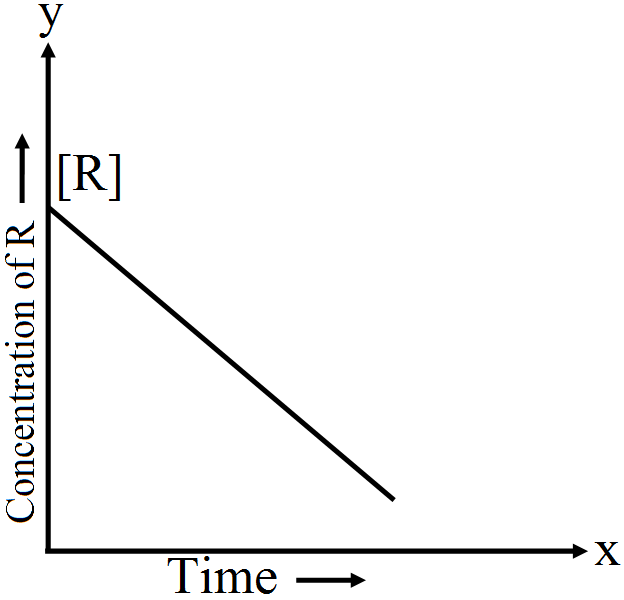
The time taken for $99\%$ reaction of $Q$ is twice the time taken for $90\%$ reaction of $R.$ The concentration of $R$ varies with time as shown in the figure given alongside.

What is the overall order of the reaction? Give the units of the rate constant for the same. Write the rate expression for the above reaction.

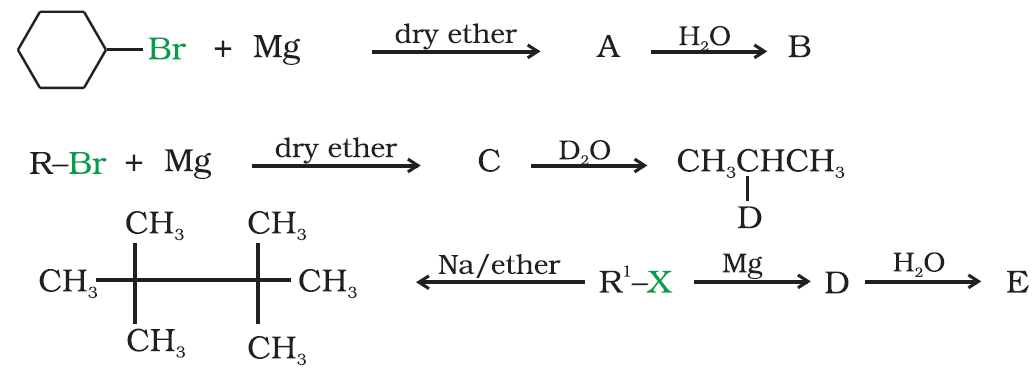
Identify A, B, C, D, E, R and $R^1$ in the following:
Answer the following questions:
Give reasons:
  1. d-block elements exhibit more oxidation states than f-block elements.
  2. Orange solution of potassium dichromate turns yellow on adding sodium hydroxide to it.
  3. Zirconium (Z = 40) and Hafnium (Z = 72) have almost similar atomic radii.