chemical reactions and equations — Science STD 10 — Question
Gujarat BoardEnglish MediumSTD 10Sciencechemical reactions and equations3 Marks
Question
Explain oxidation and reduction reactions with examples.
✓
Answer
→ The surface of copper powder becomes coated with black copper $(II)$ oxide.
→ This black substance formed because oxygen is added to copper and copper oxide is formed.
$2 Cu + O _2 \xrightarrow{\text { Heat }} 2 CuO$
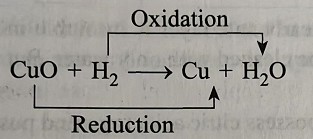
→ If $H _2$ gas is passed over this heated material $( CuO )$, the black coating on the surface turns brown as the reverse reaction takes place and copper is obtained.
$CuO + H _2 \xrightarrow{ Heat } Cu + H _2 O$ → Oxidation : If a substance gains oxygen during a reaction, it is said to be oxidised. and this reaction is called oxidation. → Reduction : If a substance loses oxygen during a reaction, it is said to be reduced. and this reaction is called reduction.
→ In reaction-2, copper $(II)$ oxide $(CuO)$ is losing oxygen and is being reduced.
→ The hydrogen is gaining oxygen and is being oxidised.
→ In other words, One reactant gets oxidised while the other gets reduced during a reaction. such reactions are called oxidation - reduction reactions or Redox reactions. ........(3)
Examples of Redox reactions :
$Zno + C \rightarrow Zn + Co$
$MnO _4+4 HCl \rightarrow MnCl _2+2 H _2 O + Cl _2$
→ In reaction- 4 carbon oxidised in to carbon monoxide and zinc oxide is reduced in to $Z n$.
→ In reaction-5, $HCl$ is oxidised in to $Cl _2$, while $MnO _2$ is reduced into $MnCl _2$.
→ So, we can say that,
"If a substance gains oxygen or loses hydrogen during a reaction, it is called oxidised substance and this process is called oxidation."
"If a substance loses oxygen or gains hydrogen during a reaction, it is called reduced substance and this process is called reduction."
Need a full question paper?
Generate a complete, print-ready paper with questions like this in minutes — across 16+ boards, with answer keys.
 ........(3)