Question
Explain (% V/V) Volume Percentage with examples.

Answer

→ "The volume of Solute (ml) dissolved in 100 ml solution is known as volume percentage (% V/V)."
→ Volume % of a component =
$\frac{\text { Volume of the component }( ml )}{\text { Total volume of solution }( ml )} \times 100$
→ For example, 10% ethanol solution in water means that 10 mL of ethanol is dissolved in water such that the total volume of the solution is 100 mL.
→ Solutions containing liquids are commonly expressed in this unit.
→ For example, a 35% (v/v) solution of ethylene glycol, an antifreeze, is used in cars for cooling the engine. At this concentration the antifreeze lowers the freezing point of water to 255.4K (-17.6°C).

Need a full question paper?

Generate a complete, print-ready paper with questions like this in minutes — across 16+ boards, with answer keys.

Start Generating Free

Similar questions

Name the four bases present in DNA. Which one of these is not present in RNA?
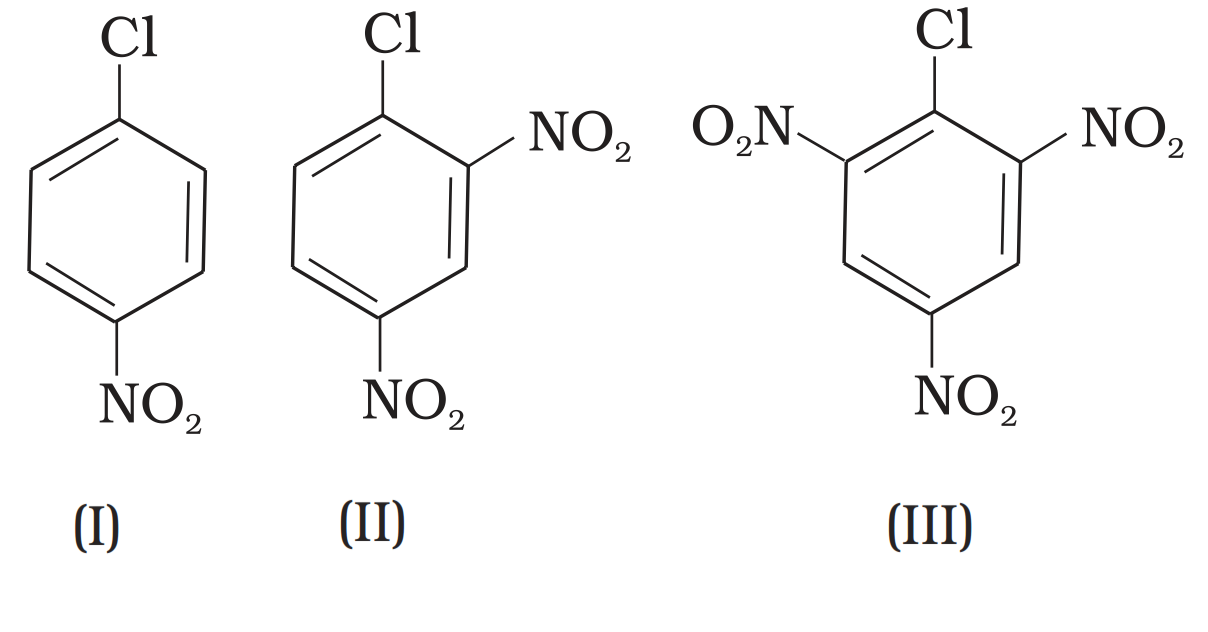
Aryl halides are extremely less reactive towards nucleophilic substitution. Predict and explain the order of reactivity of the following compounds towards nucleophilic substitution:

Image
In the above reaction sequence, write the chemical formula and IUPAC name of X and Y.
For the reaction
2NO(g) + Cl2(g) → 2 NOCl(g)
The following data were collected. All the measurements were taken at 263K:

Experiment. No. Initial [NO] (M) Initial [Cl2] (M)

Initial rate of disappearance of Cl2 (M/min)

1 0.15 0.15 0.60
2 0.15 0.30 1.20
3 0.30 0.15 2.40
4 0.25 0.25 ?
  1. Write the expression for rate law.
  2. Calculate the value of rate constant and specify its units.
  3. What is the initial rate of disappearance of Cl2 in exp. 4?
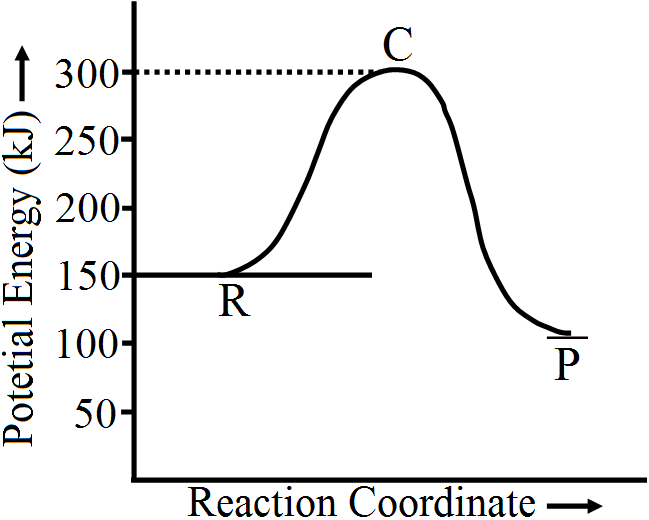
Answer the following questions on the basis of the given plot of potential energy vs reaction coordinate:

  1. What is the threshold energy for the reaction?
  2. What is the activation energy for forward reaction?
  3. What is the activation energy for backward reaction?
  4. What is enthalpy change for the forward reaction?

Give the structure of A, B and C in the following reaction:
$\text{CH}_3\text{CH}_2\text{I}\xrightarrow[]{\text{NaCN}}\text{A}\xrightarrow[\text{Partial hydolysis}]{\text{OH}^+}\text{B}\xrightarrow[]{\text{NaOH}+\text{Br}_2}\text{C}$
Why are Mn2+ compounds more stable than Fe2+ towards oxidation to their +3 state?
What may be the stable oxidation state of the transition element with the following d electron configurations in the ground state of their atoms: 3d3,
3d5, 3d8 and 3d4?
Explain with equations, the reactions to obtain hydrocarbons by reduction of aldehydes and ketones. ### Write a note on Clemmensen and Wolff- Kishner reduction.
Name the members of the lanthanoid series which exhibit +4 oxidation states and those which exhibit +2 oxidation states. Try to correlate this type of behaviour with the electronic configurations of these elements.