Question
Explain Raoult's Law for volatile solute and Volatile solvent and derive formula for total vapour pressure with graph.

Answer

→ Let us consider a binary solution of two volatile liquids and denote the two components as 1 and 2 .
→ When taken in a closed vessel, both the components would evaporate and eventually an equilibrium would be established between vapour phase and the liquid phase.
→ Suppose $p_1$ and $p_2$ partial vapour pressure of component 1 and 2 and $x_1$ and $x_2$ are MoleFraction of component 1 and 2 respectively.
→ The French chemist, Francois Marte Raoult gave the quantitative relationship between them. The relationship is known as the Raoult's law
→ "For a solution of volatile liquids the partial vapour pressure of each component of the solution is directly proportional to its mole fraction present in solution."
→ For component -1 .
$
\begin{array}{l}
p_1 \propto x_1 \\
\therefore p_1=p_1^o \cdot x_1
\end{array}
$
where $p_1^o$ is the vapour pressure of pure component 1
→ Similarly for component -2
$
\begin{array}{l}
p_2 \propto x_2 \\
\therefore p_2=p_2^o \cdot x_2
\end{array}
$
where $p_2^o$ is the vapour pressure of pure component 2
→ According to Dalton's law of partial pressures,
→ Total pressure over the solution phase in the container will be the sum of the partial pressures of the components of the solution
$\begin{aligned} p_{\text {Total }} & =p_1+p_2 \\ = & p_1^o \cdot x_1+p_2^o \cdot x_2 \\ = & p_1^o\left(1-x_2\right)+p_2^o \cdot x_2 \\ = & p_1^o-p_1^o \cdot x_2+p_2^o \cdot x_2 \\ p_{\text {Total }} & =p_1^o+x_2\left(p_2^o-p_1^o\right)\end{aligned}$
→ Following conclusions can be drawn from above equation
(i) Total vapour pressure over the solution can be related to the mole fraction of any one component.
(ii) Total vapour pressure over the solution varies linearly with the mole fraction of component 2.
(iii) Depending on the vapour pressures of the pure components 1 and 2, total vapour pressure over the solution decreases or increases with the increase of the mole fraction of component 1.
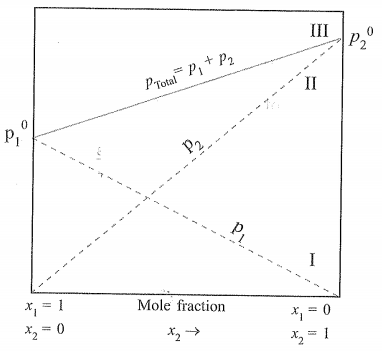
→ A plot of $p_1$ or $p_2$ versus the mole fractions $x_1$ and $x_2$ for a solution gives a linear plot as shown in Fig.
Image
→ These lines (I and II) pass through the points for which $x_1$ and $x_2$ are equal to unity.
→ Similarly the plot (line III) of $p_{\text {total }}$ versus $x_2$ is also linear Fig.
→ The minimum value of $p_{\text {Total }}$ is $p_1^o$ and the maximum value is $p_2^o$, assuming that component -1 is less volatile than component $-2\left(p_1^o < p_2^o\right)$
→ The composition of vapour phase in equilibrium with the solution is determined by the partial pressures of the components.
→ If $y_1$ and $y_2$ are the mole-fraction of the component 1 and 2 respectively in vapour phase then,
→ Using Dalton's Law of partial pressure
$\begin{array}{l}p_1=y_1 \cdot p_{\text {Total }} \\ p_2=y_2 \cdot p_{\text {Total }}\end{array}$
→ In general
$p_i=y_i\  p _{\text {Total }}$

Need a full question paper?

Generate a complete, print-ready paper with questions like this in minutes — across 16+ boards, with answer keys.

Start Generating Free

Similar questions

Derive nernst equation for Daniel cell
What is the difference between Schottky and Frenkel defect ?
The colligative properties of electrolytes require a slightly different approach than the one used for the colligative properties of non-electrolytes. The electrolytes dissociate into ions in solution. It is the number of solute particles that determines the colligative properties of a solution. The electron solutions, therefore, show abnormal colligative properties. To account for this effect we define a quantity called the van't Hoft factor, given
by
$
\begin{array}{l}
i=\frac{\text { Actual number of particles in solution a fter dissociation }}{\text { Number of formula units initially dissolved in solution }} \\
i=1 \text { (for non-electrolytes); } \\
i>1 \text { (for electrolytes, undergoing dissociation) } \\
i<1 \text { (for solutes, undergoing association). }
\end{array}
$
i. $0.1 M K _4\left[ Fe ( CN )_6\right]$ is $60 \%$ ionized. What will be its van't Hoff factor?
ii. When a solution of benzoic acid dissolved in benzene such that it undergoes in molecular association and its molar mass approaches 244. In which form Benzoic molecules will exist?
iii. How does van't Hoff factor $i$ and degree of association a are related if benzoic acid undergoes dimerisation in benzene solution? $\left( i =1 \frac{-\alpha}{2}\right.$ or $\left.i =1+\alpha\right)(2)$
OR
iii. What do you mean by colligative properties of solutions?
Explain how the molecularity of a complex reaction determined? And give the points showing difference between molecularity of a reaction and order of a reaction.
Read the following text carefully and answer the questions that follow:
The transition metals when exposed to oxygen at low and intermediate temperatures form thin, protective oxide films of up to some thousands of Angstroms in thickness. Transition metal oxides lie between the extremes of ionic and covalent binary compounds formed by elements from the left or right side of the periodic table. They range from metallic to semiconducting and deviate by both large and small degrees from stoichiometry. Since delectron bonding levels are involved, the cations-exist in various valence states and hence give rise to a large number of oxides. The crystal structures are often classified by considering a cubic or hexagonal close-packed lattice of one set of ions with the other set of ions filling the octahedral or tetrahedral interstices. The actual oxide structures, however, generally show departures from such regular arrays due in part to distortions caused by packing of ions of different size and to ligand field effects. These distortions depend not only on the number of d-electrons but also on the valence and the position of the transition metal in a period or group.
i. Why does copper, which is in first series of transition metal exhibits +1 oxidation state most frequently? (1)
ii. The lowest oxide of transition metal is basic. Why? (1)
iii. The variability in oxidation states of d-block different from that of the p-block elements. Explain. (2)
Determine the osmotic pressure of a solution prepared by dissolving 25 mg of K2SO4 in 2 litre of water at 25°C, assuming that it is completely dissociated.
Write the mechanism of hydration of ethene to yield ethanol.
What is boiling point? What is elevation of boiling point? Explain Molal elevation constant and derive It's formula.
Explain with equations, the nucleophilic addition reaction of aldehydes and ketones with alcohols. And also explain that why this reaction is carried out in the presence of dry hydrogen chloride ?