Question
Explain Rutherford's argument for scattered $\alpha$-particles.

Answer

In $\alpha$-particle scattering experiment most $\alpha$-particles pass through without being detected.
Only about $0.14 \% \alpha$-particles scatter by more than $1^{\circ}$ and about 1 in 8000 deflect by more than $90^{\circ}$.
For this Rutherford argued that for the $\alpha$-particle to be deflected backwards it must experience a large repulsive force.
This is possible only when almost entire mass of the atom is concentrated in its center and this center is positively charged.
Then incoming $\alpha$-particle could get very close to the positive charge without penetrating it and such a close encounter would result in a large deflection.
This agreement supported the hypothesis of the nuclear atom. This is why Rutherford is credited with the discovery of the nucleus.

Need a full question paper?

Generate a complete, print-ready paper with questions like this in minutes — across 16+ boards, with answer keys.
Start Generating Free

Similar questions

A plane electromagnetic wave travels in vacuum along z-direction. What can you say about the directions of its electric and magnetic field vectors? If the frequency of the wave is 30 MHz, what is its wavelength?
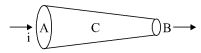
In the given figure, a current carrying conductor of non-uniform cross-section is shown. At what points, the magnitude will be maximum of (i) current (ii) current density and (iii) drift velocity?
Image
Find the area enclosed by the curve $\text{y}=\sin\text{x}$ and the X-axis between $\text{x}=0$ and $\text{x}=\pi.$
Find the moment of inertia of a pair of spheres, each having a mass m and radius r, kept in contact about the tangent passing through the point of contact.
Differentiate between primary rainbow and secondary rainbow.
At a certain location in Africa, a compass points $12^\circ$ west of the geographic north. The north tip of the magnetic needle of a dip circle placed in the plane of magnetic meridian points $60^\circ$ above the horizontal. The horizontal component of the earth’s field is measured to be $0.16 G.$ Specify the direction and magnitude of the earth’s field at the location.
A person can hear sound waves in the frequency range 20Hz to 20kHz. Find the minimum and the maximum wavelengths of sound that is audible to the person. The speed of sound is 360m/s.
A person wears glasses of power -2.5D. Is the person farsighted or nearsighted? What is the far point of the person without the glasses?
Can a gravitational field be added vectorially to an electric field to get a total field?
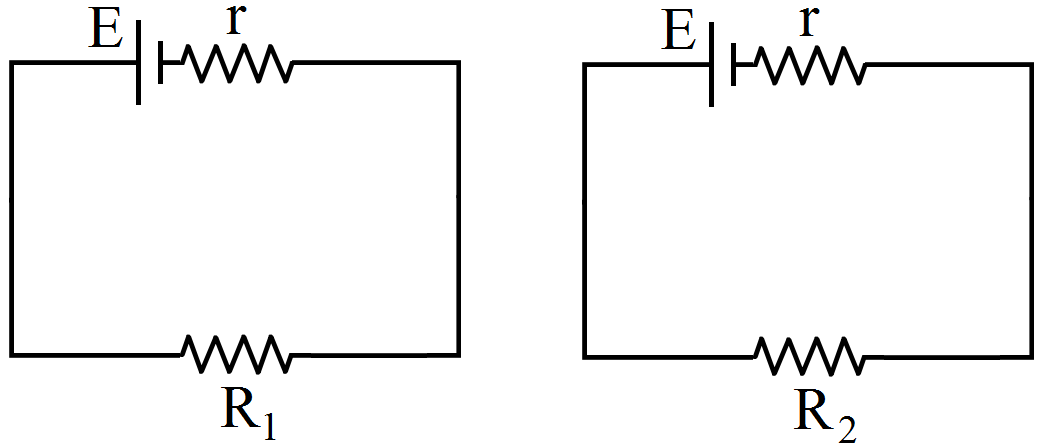
Two unequal resistances $R_1$ and $R_2$ are connected across two identical batteries of emf $\varepsilon$ and internal resistance $r$. Can the thermal energies developed in $R_1$ and $R_{2}$ be equal in a given time. If yes, what will be the condition?