Question
Explain Rutherford's argument for scattered $\alpha$-particles.

Answer

In $\alpha$-particle scattering experiment most $\alpha$-particles pass through without being detected.
Only about $0.14 \% \alpha$-particles scatter by more than $1^{\circ}$ and about 1 in 8000 deflect by more than $90^{\circ}$.
For this Rutherford argued that for the $\alpha$-particle to be deflected backwards it must experience a large repulsive force.
This is possible only when almost entire mass of the atom is concentrated in its center and this center is positively charged.
Then incoming $\alpha$-particle could get very close to the positive charge without penetrating it and such a close encounter would result in a large deflection.
This agreement supported the hypothesis of the nuclear atom. This is why Rutherford is credited with the discovery of the nucleus.

Need a full question paper?

Generate a complete, print-ready paper with questions like this in minutes — across 16+ boards, with answer keys.
Start Generating Free

Similar questions

A car weighing 1400kg is moving at a speed of 54km/h up a hill when the motor stops. If it is just able to reach the destination which is at a height of 10m above the point, calculate the work done against friction (negative of the work done by the friction).
Give brief explanation of modern solid state semi-conductor electronics.
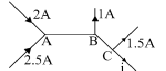
Calculate the value of $i$ as shown in the figure.
Image
Find the increase in energy of a condenser of capacity 6 µF on changing potential difference from 10 V to 20 V.
State Kirchhoff's rules. Explain briefly how these rules are justified.
If the solenoid in question 5.3 is free to turn about the vertical direction and a uniform horizontal magnetic field of 0.25 T is applied, then what is the magnitude of torque on the solenoid when its axis makes an angle of$30^{\circ}$ with the direction of applied field?
(a) Calculate the potential at a point $P$ due to a charge of $4 \times 10^{-7} C$ located $9 cm$ away.
(b) Hence obtain the work done in bringing a charge of $2 \times 10^{-9} C$ from infinity to the point P. Does the answer depend on the path along which the charge is brought?
An electric dipole is placed inside a closed surface, whose dipole moment is $20 \times 10^{-6}$ coulomb-meter. What will be the electric flux emerging out of this surface?
Answer the following questions regarding earth’s magnetism:
A vector needs three quantities for its specification. Name the three independent quantities conventionally used to specify the earth’s magnetic field.
What is the longest wavelength of photon that can ionize a hydrogen atom in its ground state? Specify the type of radiation.