Question
Explain Rutherford's nuclear atomic model and also mention its shortcomings.

Answer

SELF

Need a full question paper?

Generate a complete, print-ready paper with questions like this in minutes — across 16+ boards, with answer keys.

Start Generating Free

Similar questions

  1. How many electrons will present in sub-shell having spin quantum number value of $-\frac{1}{2}$ for n = 4?
  2. Which of the following transition will have minimum wavelength and why?

n4 → n1, n4 → n2, n2 → n1.

  1. Give the number of radial nodes for 3s and 2p orbitals.
One of the reaction that takes place in producing steel from iron ore is the
reduction of iron(II) oxide by carbon monoxide to give iron metal and CO2.
$\text{FeO (S) + CO (g)}\rightleftharpoons\text{Fe (S) + CO}_2\text{ (g)};\text{ K}_{\text{p}}=0.265\text{atm at}1050\text{K}$
What are the equilibrium partial pressures of CO and CO2 at 1050 K if the initial partial pressures are: pCO= 1.4atm and = 0.80atm?
Calculate the pH of the resultant mixture :
10 mL of $0.2 M Ca ( OH )_2+25 mL$ of 0.1 M HCI
  1. What is the total number of electrons in $\text{NO}^-_3$ and $\text{NH}^+_4?$
  2. Why is melting point of MgO (2800°C) higher than that of BaO (1920°C)?
  3. Why is solubility of MgCl, greater than that of MgF2?
  4. Why are carbon-oxygen bond lengths in Na2CO3 equal?
  5. Why is AlF3 high melting solid whereas SiF4 is a gas?
1. Suggest a method to purify
i. a liquid which decomposes at its boiling point.
ii. kerosene oil containing water.
iii. camphor containing traces of common salt.
2. Differentiate between the principle of estimation of nitrogen in an organic compound
i. Dumas method
ii. Kjeldahl's method.
What are Lewis acids and Lewis bases? Explain with different types of examples.
Derive the relationship between equilibriumconstant (K), reaction constant (Q) and Gibbs energy (G) and explain spontaneity of reaction with help of it.
  1. Define solubility product. Write solubility product expression for Zr3(PO4)4.
  2. Calculate the pH of 0.01 M CH3COOH solution. [Ka(CH2COOH) = 1.74 × 10-51
  3. Explain why NaCl is precipitated when HCl(g) is passed through the saturated solution of NaCl.
$\text{K}_{\text{c}}\text{ for }\text{PCl}_5(\text{g})\rightleftharpoons\text{PCl}_3(\text{g})+\text{Cl}_2(\text{g})\text{ is }0.04\text{ at }25^\circ\text{C}.$
How much moles of PCl5 must be added to 3L flask to obtain a chlorine concentration of 0.15M.
Attempt any five of the following:
1. If $Qc < Kc$, when we continuously remove the product, what would be the direction of the reaction?
2. Explain the reason for the extraordinary stability of benzene in spite of the presence of three double bonds in it.
3. What effect does branching of an alkene chain has on its boiling point?
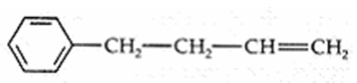
4. Write the IUPAC name:
Image
5. How will you demonstrate that double bonds of benzene are somewhat different from that of olefines?
6. Why do alkynes not show geometrical isomerism?
7. Write an IUPAC name:
Image