Question
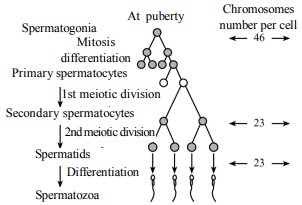
Explain spermatogenesis.

Need a full question paper?

Generate a complete, print-ready paper with questions like this in minutes — across 16+ boards, with answer keys.

Start Generating Free

Similar questions

(i) Define the pollination.
(ii) Explain the process of double fertilization.
(iii) Draw a well labelled diagram of fertilized
embryo sac.
"It is often said that the pyramid of energy is always upright. On the other hand, the pyramid of biomass can be both upright and inverted." Explain with the help of examples and sketches.
Answer the following questions:
Seeds offer several advantages to angiosperms. Describe any three such advantages.
Name three species of fungi that cause ringworm. Mention the symptoms of this disease?
What are the two groups of cells that work for specific immunity? Explain four unique features of specific immunity.
Answer the following questions:
You are given tall pea plants with yellow seeds whose genotypes are unknown. How would you find the genotype of these plants? Explain with the help of cross.
The density of a population in a habitat per unit area is measured in different units. Write the unit of measurement against the following:
a.
Bacteria
____________
b.
Banyan
____________
c.
Deer
____________
d.
Fish
____________
Answer the following questions:
At which stage of life does gametogenesis begin in human male and female respectively?
Read the following and answer any four questions from (i) to (v) given below:

Crown gall is a neoplastic disease of most dicotyledonous plants and is caused by the soil bacterium Agrobacterium tumefaciens. A large extra chromosomal plasmid in these bacteria was found to be responsible for this disease. The plasmid is known as Ti plasmid. Bacteria free crown gall cells can be cultured in the absence of phytohormones. Ti plasmid is widely used in genetic engineering to deliver the desirable genes. The part of Ti plasmid transferred into plant cell DNA is called T-DNA. T-DNA with desired DNA segment is inserted into the chromosome of the host plant where it produces copies of itself.

  1. Which of the following is the full full of T-DNA?
  1. Transfer DNA.
  2. Tumour inducing DNA.
  3. Transgenic DNA.
  4. None of these.
  1. Ti plasmid cannot infect and develop crown gall in,
  1. Tomato.
  2. Maize.
  3. Soybean.
  4. sunflower.
  1. While making transgenic plant, T-DNA is inserted into the host cell, it is then:
  1. Integrated into the target host genome.
  2. Lie independent of the host genome.
  3. Rupture the host cell wall.
  4. Produce oncogenic factors in the host.
  1. Agrobacterium mediated gene transfer in plants:
  1. Allows relatively large segment of DNA.
  2. Transfer of DNA with defined ends and minimal rearrangement.
  3. High quality and fertility in transgenic plants.
  4. All of these.
  1. Assertion: In Agrobacterium mediated gene transfer in plants, transgenic plants do not develop tumors.

Reason: In T-DNA tumor producing genes are deleted during the process of gene transfer.
  1. Both assertion and reason are true and reason is the correct explanation of assertion.
  2. Both assertion and reason are true but reason is not the correct explanation of assertion.
  3. Assertion is true but reason is false.
  4. Both assertion and reason are false.
Write a short note on pyramid of numbers and pyramid of biomass.