Theories of Employment and Income — Economics STD 12 — Question
Tamilnadu BoardEnglish MediumSTD 12EconomicsTheories of Employment and Income5 Marks
Question
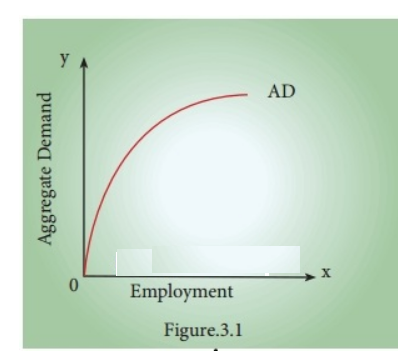
Explain the Aggregate Demand Function with Diagram?
✓
Answer
In the Keynesian model, output is determined mainly by aggregate demand.
The aggregate demand is the amount of money which entrepreneurs expect to get by selling the output produced by the number of labourers employed.
Therefore, it is the expected income or revenue from the sale of output at different levels of employment.
Aggregate demand has the following four components:
Consumption demand
Investment demand
Government expenditure and
Net Export (export – import)
The desired or planned demand (spending) is the amount that households, firms, the governments and the foreign purchasers would like to spend on domestic output.
In other words, desired demand in the economy is the sum total of desired private consumption expenditure, desired investment expenditure, desired government spending and desired net exports (difference between exports and imports).
Thus, the desired spending is called aggregate spending (demand), and can be expressed as: AD = C + I + G + (X – M)
The diagram explains that aggregate demand price increases or decreases with an increase or decrease in the volume of employment.
Aggregate demand curve increases at an increasing rate in the beginning and then increases at a decreasing rate.
This shows that as income increases owing to increase in employment, expenditure of the economy increases at a decreasing rate.
Need a full question paper?
Generate a complete, print-ready paper with questions like this in minutes — across 16+ boards, with answer keys.