Question
Explain the bonding in coordination compounds in terms of Werner’s postulates.

Answer

The main postulates of Werner's theory of coordination compounds are as follows:
  1. Metals possess two types of valencies called
  1. Primary valency which are ionisable;
  2. secondary valency which are non- ionisable
  1. Primary valency is satisfied by the negative ions and it is that which a metal exhibits in the formation of its simple salts.
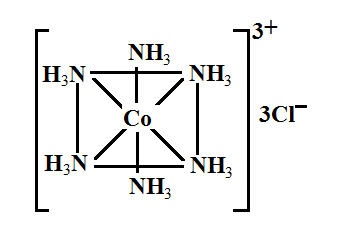
  2. Secondary valencies are satisfied by neutral ligand or negative ligand and are those which metal exercises in the formation of its complex ions. Every cation has a fixed number of secondary valencies which are directed in space about central metal ion in certain fixed directions, e.g,, In $CoCl_3-6NH_3$, valencies between Co and Cl are primary valencies and valencies between Co and NH_3are secondary. In $COCl_3-6NH_3$, six ammonia molecules linked to Co by secondary valencies are directed to six corners of a regular octahedron and thus account for structure of $COCl_3-6NH_3$ as follows:
In modern theory, it is now referred as coordination number of central metal atom or ion.

Need a full question paper?

Generate a complete, print-ready paper with questions like this in minutes — across 16+ boards, with answer keys.
Start Generating Free

Similar questions

Define the term solution. How many types of solutions are formed? Write briefly about each type with an example.
Discuss the classification of monohydric alcohols containing $C_{sp}^3-OH$ bond.
Calculate the mass of ascorbic acid $($Molar mass $= 176g\ mol^{-1})$ to be dissolved in $75$g of acetic acid, to lower its freezing point by $1·5^\circ C. (K_f = 3.9K\ kg\ mol^{-1})$
For the reaction $R\rightarrow P,$ the concentration of a reactant changes from $0.03 M$ to $0.02 M$ in $25$ minutes. Calculate the average rate of reaction using units of time both in minutes and seconds.
Write chemical reaction to affect the following transformation.
(ii) Acetone to propane
Explain with chemical reactions, the formation of anhydrides and esters from carboxylic acids.
Write the structures of the monomers used for getting the following polymers:
  1. Nylon$-6, 6.$
  2. Melamine-formaldehyde polymer.
  3. Buna-S.
State Raoult’s law for a solution containing volatile components. How does Raoult’s law become a special case of Henry’s law?
Why haloalkanes undergo nucleophilic substitution reaction whereas haloarenes undergo electrophilic substitution reaction, why?
What mass of $\mathrm{NaCl}\left(\right.$ molar mass $\left.=58.5 \mathrm{~g} \mathrm{~mol}^{-1}\right)$ must be dissolved in $65$ g of water to lower the freezing point by $7.50^{\circ} \mathrm{C}$ ? The freezing point depression constant, $\mathrm{K}_{\mathrm{f}}$, for water is $1.86 \mathrm{~K} \mathrm{~kg} \mathrm{~mol}^{-1}$. Assume van't Hoff factor for $NaCl$ is $1.87.$