Question
Explain the capillary action.
Answer

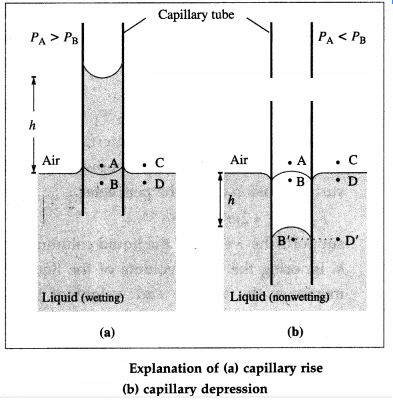
(1) When a capillary tube is partially immersed in a wetting liquid, there is capillary rise and the liquid meniscus inside the tube is concave, as shown in below figure.Consider four points A, B, C, D, of which point A is just above the concave meniscus inside the capillary and point B is just below it. Points C and D are just above and below the free liquid surface outside.
Let $P_A, P_B, P_C$​​​​​​​ and $P_D​​​​​​​$​​​​​​​ be the pressures at points A, B, C and D, respectively.
Now, $P_A = P_C$​​​​​​​ = atmospheric pressure
The pressure is the same on both sides of the free surface of a liquid, so that
Image
The pressure on the concave side of a meniscus is always greater than that on the convex side, so that
$ P _{ A }> P _{ B }$
$\therefore P _D> P _{ B }\left(\because P _{ A }= P _{ D }\right) $
The excess pressure outside presses the liquid up the capillary until the pressures at $B$ and $D$ (at the same horizontal level) equalize, i.e., $P_B$ becomes equal to $P_D$. Thus, there is a capillary rise.
(2) For a non-wetting liquid, there is capillary depression and the liquid meniscus in the capillary tube is convex, as shown in above figure.
Consider again four points A, B, C and D when the meniscus in the capillary tube is at the same level as the free surface of the liquid. Points A and B are just above and below the convex meniscus. Points C and D are just above and below the free liquid surface outside.
The pressure at $B\left( P _{ B }\right)$ is greater than that at $A \left( P _{ A }\right)$. The pressure at $A$ is the atmospheric pressure $H$ and at $D_1 P _{ D } \simeq H = P _{ A }$. Hence, the hydrostatic pressure at the same levels at $B$ and $D$ are not equal, $P_B>P_D$. Hence, the liquid flows from $B$ to $D$ and the level of the liquid in the capillary falls. This continues till the pressure at $B^{\prime}$ is the same as that $D^{\prime}$, that is till the pressures at the same level are equal.

Need a full question paper?

Generate a complete, print-ready paper with questions like this in minutes — across 16+ boards, with answer keys.

Start Generating Free

Similar questions

Distinguish between stationary waves and beats. (Two points of distinction)
State the Bio-Savart law (Laplace law) for the magnetic induction produced by a current element. Express it in vector form.
How is the magnetic field of a small current loop identical to that of a short magnetic dipole? Explain.###Explain the equivalence of the fields of a current-carrying circular coil and a magnetic dipole.
Permeability and Permittivity:
Magnetic Permeability is a term analogous to permittivity in electrostatics. It basically tells us about the number of magnetic lines of force that are passing through a given substance when it is kept in an external magnetic field. The number is the indicator of the behaviour of the material in magnetic field. For superconductors χ = – 1. If you substitute in the Eq. (11.18), it is observed that permeability of material µ = 0. This means no magnetic lines will pass through the superconductor.

Magnetic Susceptibility (χ) is the indicator of measure of the response of a given material to the external applied magnetic field. In other words it indicates as to how much magnetization will be produced in a given substance when kept in an external magnetic field. Again it is analogous to electrical susceptibility. This means when the substance is kept in a magnetic field, the atomic dipole moments either align or oppose the external magnetic field. If the atomic dipole moments of the substance are opposing the field, χ is observed to be negative, and if the atomic dipole moments align themselves in the direction of field, χ is observed to be positive. The number of atomic dipole moments of getting aligned in the direction of the applied magnetic field is proportional to χ. It is large for soft iron (χ >1000).

The equation of linear SHM is a: $=10 \sin \left(4 \pi t+\frac{1}{24}\right) cm$. Find the amplitude, period and phase constant of the motion. Also, find the phase angle $\frac{1}{24}$ second after the start.
How does an aeroplane take off?
Derive an expression for the work done during an isothermal process
$104 J$ of work is done on certain volume of a gas. If the gas releases $125 \ kJ$ of heat, calculate the change in internal energy of the gas.
With a neat ray diagram, explain the resolving power of a telescope. On what factors does it depend?
OR
What is meant by the angular limit of resolution and resolving power of a telescope?
State and prove the theorem of 'parallel axes'.
The optical path of a ray of light of a given wavelength travelling a distance of $3\ cm$ in flint glass having refractive index $1.6$ is same as that on travelling a distance x cm through a medium having refractive index $1.25$. Determine the value of x.