Question
Explain the close relationship between the internal structure of an atom and the emission spectrum.

Answer

Every substance (solid, liquid and gas) emits electromagnetic radiation at every temperature. This radiation contains many different wavelengths. Among these, some wave lengths are continuously distributed but their intensity varies.
This radiation arises due to the oscillations of atoms and molecules.
By heating or exciting a gas of sufficiently low density, the light emitted from it contains only a few discrete or specific wave lengths. This spectrum appear as a series of light.
Gases with sufficiently low density have more space between atoms. Hence the emitted radiation can be assumed to be due to individual atoms rather than interactions between molecules or atoms.
Each element is associated with a characteristic spectrum of radiation. For example, hydrogen always gives a set of lines with fixed relative position between the lines. Means they are at certain fixed locations.
This fact shows that there is a close relationship between the internal structure of an atom and the spectrum of radiation emitted by it.
Need a full question paper?

Generate a complete, print-ready paper with questions like this in minutes — across 16+ boards, with answer keys.

Start Generating Free

Similar questions

Consider a circuit containing an ideal battery connected to a resistor. Do "work done by the battery" and "the thermal energy developed" represent two names of the same physical quantity?
A monochromatic light source of frequency $ 6\times10^{14} $ Hz emitts $ 2\times10^{-3} $ Joule energy per second. Calculate the number of photons emitted by the source per second.
Answer the following questions:
  1. Optical and radio telescopes are built on the ground while X-ray astronomy is possible only from satellites orbiting the Earth. Why?
  2. The small ozone layer on top of the stratosphere is crucial for human survival. Why ?
Can a gravitational field be added vectorially to an electric field to get a total field?
Suppose you are told that the linear size of everything in the universe has been doubled overnight. Can you test this statement by measuring sizes with a metre stick? Can you test it by using the fact that the speed of light is a universal constant and has not changed? What will happen if all the clocks in the universe also start running at half the speed?
Two voltameters, one having a solution of silver salt and the other of a trivalent-metal salt, are connected in series and a current of 2A is maintained for 1.50 hours. It is found that 1.00g of the trivalent-metal is deposited.
  1. What is the atomic weight of the trivalent metal?
  2. How much silver is deposited during this period? Atomic weight of silver is 107.9 g/mole.
Why is there no dispersion in the light refracted through a rectangular glass slab?
Suppose $\vec{\text{a}}$ is a vector of magnitude 4.5 unit due north. What is the vector:
  1. $3\vec{\text{a}}$
  2. $-4 \ \vec{\text{a}}?$
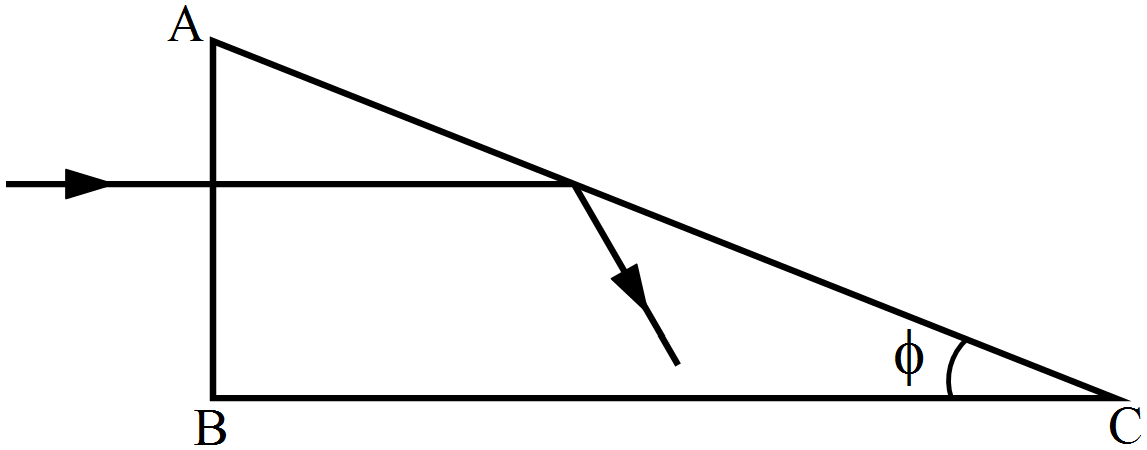
 A light ray is incident normally on the face AB of a right-angled prism ABC $(\mu=1.50)$ as shown in figure. What is the largest angle $\phi$ for which the light ray is totally reflected at the surface AC? 
Answer the following questions: In viewing through a magnifying glass, one usually positions one's eyes very close to the lens. Does angular magnification change if the eye is moved back?