Tamilnadu BoardEnglish MediumSTD 11PhysicsKinematics5 Marks
Question
Explain the concept of relative velocity in one and two dimensional motion.
✓
Answer
When two objects A and B are moving with different velocities, then the velocity of one object A with respect to another object B is called relative velocity of object A with respect to B.
Case I:
Consider two objects $A$ and $B$ moving with uniform velocities $V_A$ and $V_B$, as shown, along straight tracks in the same direction $\overrightarrow{V}_{ A }, \overrightarrow{ V }_{ B }$ with respect to ground.
The relative velocity of object $A$ with respect to object $B$ is $\vec{V}_{A B}=\vec{V}_A-\vec{V}_B$.
The relative velocity of object $B$ with respect to object $A$ is $\vec{V}_{B A}=\vec{V}_B-\vec{V}_A$ Thus, if two objects are moving in the same direction, the magnitude of relative velocity of one object with respect to another is equal to the difference in magnitude of two velocities.
Case II.
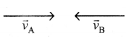
Consider two objects $A$ and $B$ moving with uniform velocities $\vec{V}_A$ and $\vec{V}_{ B }$ along the same straight tracks but opposite in direction.
The relative velocity of an object $A$ with respect to object $B$ is -
$
\overrightarrow{ V }_{ AB }=\overrightarrow{ V }_{ A }-\left(-\overrightarrow{ V }_{ B }\right)=\overrightarrow{ V }_{ A }+\overrightarrow{ V }_{ B }
$
The relative velocity of an object $B$ with respect to object $A$ is
$
\overrightarrow{ V }_{ AB }=-\overrightarrow{ V }_{ A }-\overrightarrow{ V }_{ A }=-\left(\overrightarrow{ V }_{ A }+\overrightarrow{ V }_{ B }\right)
$
Thus, if two objects are moving in opposite directions, the magnitude of relative velocity of one object with respect to other is equal to the sum of magnitude of their velocities.
Case III.
Consider the velocities $\vec{v}_{ A }$ and $\overrightarrow{ v }_{ B }$ at an angle $\theta$ between their directions. The relative velocity of $A$ with respect to $B, \vec{v}_{A B}=\vec{v}_A-\vec{v}_B$
Then, the magnitude and direction of $\overrightarrow{ v }_{ AB }$ is given by $\overrightarrow{ v }_{ AB }=\sqrt{\vec{v}_{ A }^2+\vec{v}_{ B }^2-2 v_{ A } v_{ B } \cos \theta}$ and $\tan \beta=\frac{v_{ B } \sin \theta}{v_{ A }-v_{ B } \cos \theta}$ (Here $\beta$ is angle between $\left(\overrightarrow{ v }_{ B }\right.$ and $\overrightarrow{ v }_{ A }$ ) $\overrightarrow{ v }_{ A }-\overrightarrow{ v }_{ B } \cos \theta$.
(i) When $\theta=0$, the bodies move along parallel straight lines in the same direction, We have $\overrightarrow{ v }_{ AB }=\left(\overrightarrow{ v }_{ A }-\overrightarrow{ v }_{ B }\right)$ in the direction of $\overrightarrow{ v }_{ A }$. Obviously $\overrightarrow{ v }_{ BA }=\left(\overrightarrow{ v }_{ B }+\overrightarrow{ v }_{ A }\right)$ in the direction of $\overrightarrow{ v }_{ B }$.
(ii) When $\theta=180^{\circ}$, the bodies move along parallel straight lines in opposite directions, We have $\overrightarrow{ v }_{ AB }=\left(\overrightarrow{ v }_{ A }+\overrightarrow{ v }_{ B }\right)$ in the direction of $\overrightarrow{ v }_{ A }$. Similarly, $vBA =( vB + vA )$ in the direction of $\vec{v}_B$.
(iii) If the two bodies are moving at right angles to each other, then $0=90^{\circ}$. The magnitude of the relative velocity of $A$ with respect to $B =\overrightarrow{ v }_{ AB }=\sqrt{v_{ A }^2+v_{ B }^2}$.
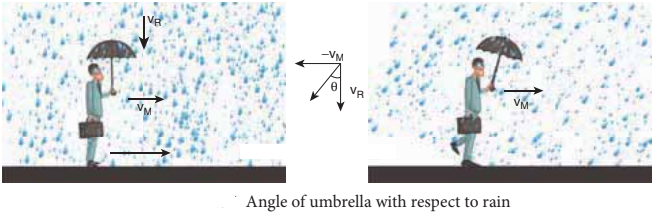
(iv) Consider a person moving horizontally with velocity $\overrightarrow{ V }_{ M }$. Let rain fall vertically with velocity $\vec{V}_R$. An umbrella is held to avoid the rain. Then the relative velocity of the rain with respect to the person is,
which has magnitude
$
\overrightarrow{ V }_{ RM }=\overrightarrow{ V }_{ R }-\overrightarrow{ V }_{ M }
$
And direction $0=\tan ^{-1}\left(\frac{V_{ M }}{V_{ R }}\right)$ with the vertical as shown in figure.
Need a full question paper?
Generate a complete, print-ready paper with questions like this in minutes — across 16+ boards, with answer keys.