Question
Explain the concepts of ideal gas.

Answer

Ideal gas :
(i) Ideal gas completely follows the laws of Boyle's, Charles's and pressure in every condition of temperature, pressure and volume.
(ii) If coefficient of pressure expansion and coefficients of volume expansions are equal to each other and it value is 1/273.
(iii) No force of attraction or repulsion acts between its molecules.
(iv) Its molecules are very small.
(v) Ideal gas cannot be changed into solid or liquid state because attraction between molecules is necessary in liquid and solid states.
(vi) The gas which follows the assumptions of dynamic theory is called ideal gas.
(vii) Generally monoatomic gases are ideal gases. Hydrogen, nitrogen, oxygen and helium gases are ideal gases. It is believed that because all of them are liquid with difficulty.
Need a full question paper?

Generate a complete, print-ready paper with questions like this in minutes — across 16+ boards, with answer keys.

Start Generating Free

Similar questions

The electric field in a region is given by $\overrightarrow{\text{E}}=\frac{3}{5}\text{E}_0\overrightarrow{\text{i}}+\frac{4}{5}\text{E}_0\overrightarrow{\text{j}}$ with $\text{E}_0=2.0\times10^3\text{NC}^{-1}.$ Find the flux of this field through a rectangular surface of area $0.2m^2$ parallel to the y-z plane.
A hydrogen atom in state $n = 6$ makes two successive transitions and reaches the ground state. In the first transition a photon of $1.13eV$ is emitted. $(a)$ Find the energy of the photon emitted in the second transition $(b)$ What is the value of n in the intermediate state?
A wave travelling along a string is described by,
$
y(x, t)=0.005 \sin (80.0 x-3.0 t) \text {, }
$
in which the numerical constants are in SI units $\left(0.005 m , 80.0 rad m ^{-1}\right.$, and $3.0 rad s ^{-1}$ ). Calculate (a) the amplitude, (b) the wavelength, and (c) the period and frequency of the wave. Also, calculate the displacement $y$ of the wave at a distance $x=30.0 cm$ and time $t=20 s ?$
When two vectors $\vec{\text{A}}$ and $\vec{\text{B}}$ inclined at angle $\theta$ act on a body, the resultant is $(2\text{k}+1)\sqrt{\text{A}^2+\text{B}^2}.$ When the vectors are inclined at an angle $(90^\circ-\theta),$ the resultant is $(2\text{k}-1)\sqrt{\text{A}^2+\text{B}^2},$ prove that $\tan\theta=\frac{\text{k}-1}{\text{k}+1}.$
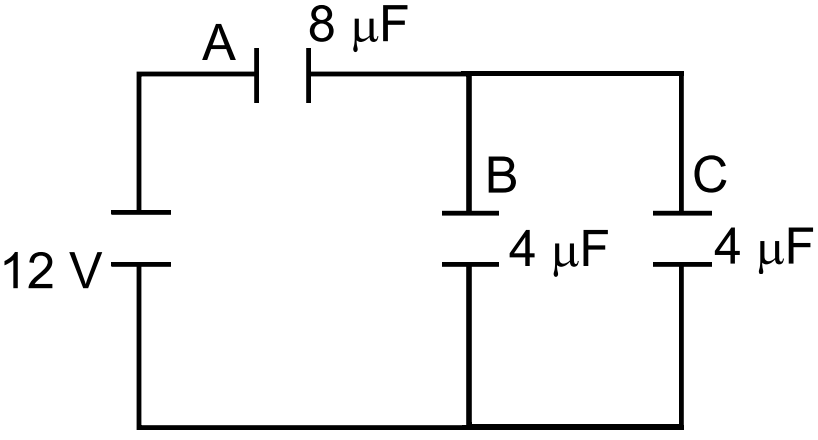
Find the charge appearing on each of the three capacitors shown in figure.
A particle of mass $0.2kg$ attached to a massless string is moving in a vertical circle of radius $1.2m$. It is imparted a speed of $8ms^{-1}$ at the lowest point of its circular path. Does the particle complete the vertical circle? What is the change is tension in the string when the particle moves from the position where the string is vertical to the position where the string is horizontal?
In a children's park a heavy rod is pivoted at the centre and is made to rotate about the pivot so that the rod always remains horizontal. Two kids hold the rod near the ends and thus rotate with the rod (fig). Let the mass of each kid be 15 kg, the distance between the points of the rod where the two kids hold it be 3.0 m and suppose that the rod rotates at the rate of 20 revolutions per minute. Find the force of friction exerted by the rod on one of the kids.
A boy throws a ball in air at 60° to the horizontal along a road with a speed of 10m/ s (36km/ h). Another boy sitting in a passing by car observes the ball. Sketch the motion of the ball as observed by the boy in the car, if car has a speed of (18km/ h). Give explanation to support your diagram.
Given that the time period T of oscillation of a gas bubble from an explosion under water depends upon P, d and E where P is the static pressure, d the density of water and E is the total energy of explosion, find dimensionally a relation for T.
An ideal refrigerator runs between $-23°C$ and $27°C$,
  1. Find the heat rejected to atmosphere for every joule of work input.
  2. Also, find heat extracted from cold body.
  3. Find coefficient of performance of the refrigerator.