Question
Explain the construction and propagation of a spherical wavefront using Huygens’ principle.

Answer

Get the step-by-step solution for this question inside the Vidyadip app.

Get the answer in the app

Need a full question paper?

Generate a complete, print-ready paper with questions like this in minutes — across 16+ boards, with answer keys.
Start Generating Free

Similar questions

A device $Y$ is connected across an $AC$ source of emf $e = e_0$ sinωt. The current through $Y$ is given as $i = i_0 \sin(\omega t + \pi /2)$
a) Identify the device $Y$ and write the expression for its reactance.
b) Draw graphs showing variation of emf and current with time over one cycle of AC for $Y$.
c) How does the reactance of the device $Y$ vary with the frequency of the $AC$ ? Show graphically
d) Draw the phasor diagram for the device $Y$.
On the basis of the kinetic theory of gases, explain
(i) positive work done by a system
(ii) negative work done by a system.
The period of oscillation of a simple pendulum increases by $20 \%$ when the length of the pendulum is increased by $44 cm$. Find its
(i) initial length
(ii) initial period of oscillation at a place where $g$ is $9.8 m / s ^2$.
What is the sign convention used for Kirchhoff's second law ? Explain with an example.
Define the coefficients of absorption, reflection and transmission. Obtain the relation between them.
State Boyle's law. Deduce it on the basis of the kinetic theory of an ideal gas.
OR
Deduce Boyle's law using the expression for pressure exerted by an ideal gas.
A proton is released from rest in vacuum in a uniform electric field of intensity $100 V / m$. What is its speed after it has travelled a distance of $1 m \ ?\ [m _{ p }=1.67 \times 10^{-27} \ kg , 1 eV =1.6 \times  \left.10^{-19} J \right]$
Define phase of S.H.M. Show variation of displacement, velocity and acceleration with phase for a particle performing linear S.H.M. graphically, when it starts from extreme position.
Derive an expression for minimum speed to perform stunts in well of death.
Part of a racing track is to be designed for a radius of curvature of $288 m$. We are not recommending the vehicles to drive faster than $216 \ km/hr$. With what angle should the road be tilted?
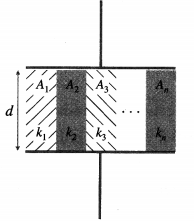
A parallel-plate capacitor consists of $n$ dielectric slabs of end-face areas $A_1, A_2 \ldots \ldots \ldots . ., A_n$ and respective relative permittivities (dielectric constants) $k_1, k_2, \ldots ., k_n$, in the space between the plates as shown in below figure. Find the equivalent capacitance of this arrangement. Hence, show that if the areas are equal, the capacitance is $C=\frac{\varepsilon_0 A}{n d} \sum_j k_j$.
Image